
Why We Swapped Our 79 Series for an INEOS Quartermaster
After almost two years, 60,000 kilometres and roughly 400 nights travelling in our LandCruiser 79 Series, we sold it and started again with an INEOS Grenadier Quartermaster. Here’s why.

Why would you sell a LandCruiser 79 Series??
Our 79 hadn’t let us down. We weren’t unhappy with it. And after almost two years travelling around Australia, we’d built it into a setup that worked incredibly well for us.
But spending that much time living and travelling out of one vehicle also teaches you exactly what you need — and what you don’t.
More importantly, our life had changed.
So rather than building another version of the same thing, we decided it was time to take everything we’d learned from the 79 and build something different.
That’s where the INEOS Grenadier Quartermaster came in.
There Was Nothing Wrong With Our 79 Series
This is probably the most important thing to explain.
We didn’t move away from the LandCruiser because it was a bad vehicle.
Quite the opposite.
We travelled around 60,000 kilometres in our 2024 LandCruiser 79 Series and spent roughly 400 nights living out of the Tommy Camper on the back. It took us across some seriously remote parts of Australia and became our home on wheels. For the type of travelling we were doing at the time, particularly through Western Australia, the 79 made a lot of sense. There’s a reason you see so many LandCruisers once you start travelling through remote Australia.
Western Australia really is Cruiser Country.
But there’s probably one important difference between us and a lot of Australian 79 Series owners.
We’re Europeans. We didn’t grow up with LandCruisers.
We didn’t grow up watching 79s working on farms or travelling through the Australian Outback, so we don’t have the same lifelong emotional connection to the LandCruiser that many Australians do.
And our 79 wasn’t the legendary V8 either. We owned the newer 2.8-litre four-cylinder with the six-speed automatic, so for us it was never really about owning an iconic 79 — it was about choosing the right vehicle for the job.
There’s another important part to this as well. We weren’t looking to replace our 79 with a second-hand V8. If we were going to start again, we wanted to buy a new vehicle. And you can’t walk into a Toyota dealership and order a new V8 79 Series anymore.
So for us, the real question wasn’t whether we’d choose an INEOS Quartermaster over the legendary V8 79 Series. It was: if we were buying a brand-new 4WD today, what would we choose?
We already knew the current 2.8-litre four-cylinder 79 Series very well. We’d driven ours almost 60,000 kilometres around Australia and knew exactly what we liked about it — and what we wanted to improve with our next build.
Looking at the new-vehicle market from that perspective, the INEOS Quartermaster simply made more sense to us. We still get the rugged 4WD foundations we want, but with the BMW straight-six diesel, ZF eight-speed automatic, coil suspension and a much more modern and comfortable driving experience.
For what we want from a new 4WD today, we believe the INEOS is the better platform for our next build.
But Our 79 Had Become a Very Big 4WD
Our 79 wasn’t exactly standard. It had a 300mm chassis extension, a heavy-duty tray and our Tommy Campers S6X on the back. That created an amazing platform for long-distance touring. We had plenty of room, plenty of storage and a camper we could comfortably live out of for months at a time. But there was a trade-off.
It was big!
For long stretches of highway, open outback roads and remote touring, that wasn’t really a problem. Once tracks became tighter and more technical, however, you definitely knew you were driving a long, heavy touring vehicle. And over time, we started asking ourselves whether we actually needed all that size.
The Biggest Change Wasn’t the Vehicle. It Was Us.
When we originally built the 79, we were spending huge amounts of time on the road. Our setup needed to be our home. Today, our situation is different.
We’re now based on the Sunshine Coast, which means the vehicle isn’t only going to be used for months-long trips around Australia. It’ll also be our everyday 4WD. Our future travelling will be a mixture of big remote trips, shorter getaways and more technical 4WDing. Places like the Victorian High Country are becoming more appealing to us, where a shorter and more nimble vehicle starts to make a lot more sense. At the same time, we still want to travel remotely. We still want plenty of water and fuel. We still want a proper 4WD. And most importantly, we still want a Tommy Camper on the back. So the concept hasn’t really changed.
We’re just refining it.
We Didn’t Want to Build Another Heavily Modified 79
There was another big lesson we took away from our 79 Series build.
We didn’t want to buy another vehicle and then have to change almost everything to make it suit us. Our 79 was a great touring vehicle, but getting it to that point required a lot of work. Suspension, GVM upgrade, chassis extension, track correction, brakes, rear diff, interior upgrades and plenty more all had to be changed or upgraded to create the vehicle we eventually travelled Australia in.
And that’s not unusual. Look at most serious touring 79s in Australia and you’ll see just how much gets changed.
After living with ours for almost 60,000 kilometres, though, we started to question that approach.
One of the biggest attractions of a 79 Series is its simplicity. It’s an old-school, relatively simple 4WD — and that’s a huge part of why people love them.
If you start modifying almost every part of that vehicle, at what point do you start losing the very simplicity you bought a 79 Series for?
Every modification adds another component, another system and potentially another point of failure. Eventually, you can end up with a much more complicated vehicle than the simple 79 you started with. We felt we’d reached that point with our build. And that’s another reason the INEOS Grenadier Quartermaster appealed to us.
Why the INEOS Quartermaster Caught Our Attention
The INEOS Quartermaster caught our attention because it sits in a pretty unique position in the 4WD market. For us, it combines the best of both worlds. It still has the traditional 4WD foundations we want — a ladder-frame chassis, solid axles, low range, permanent four-wheel drive and locking differentials — but combines them with a modern drivetrain, coil suspension and a much more comfortable and refined cabin.
That was important to us after almost 60,000 kilometres in the 79. We didn’t want a luxury SUV pretending to be an off-roader, but we also realised there was no reason a serious touring 4WD couldn’t be comfortable and enjoyable to drive every day. The INEOS Quartermaster seemed to offer exactly that middle ground: old-school 4WD where it matters, with modern engineering and comfort where we wanted it.
Another big attraction was how capable the vehicle already is from the factory. With the 79, we had to modify a huge amount of the vehicle to eventually create the touring setup we wanted.
The more we modified it, the further we felt we were moving away from one of the biggest strengths of a 79 Series in the first place — its simplicity.
We’re obviously still modifying the Quartermaster. We’re building a 4-tonne touring vehicle carrying a Tommy Camper, so upgrades are unavoidable. But this time we’re starting with a platform that already has many of the fundamentals we want. Instead of completely transforming the base vehicle, the goal is to enhance what’s already there.
For us, that was a big part of the appeal of starting Bush and Bay 3.0 with an INEOS Quartermaster.
BMW Straight-Six + ZF Eight-Speed
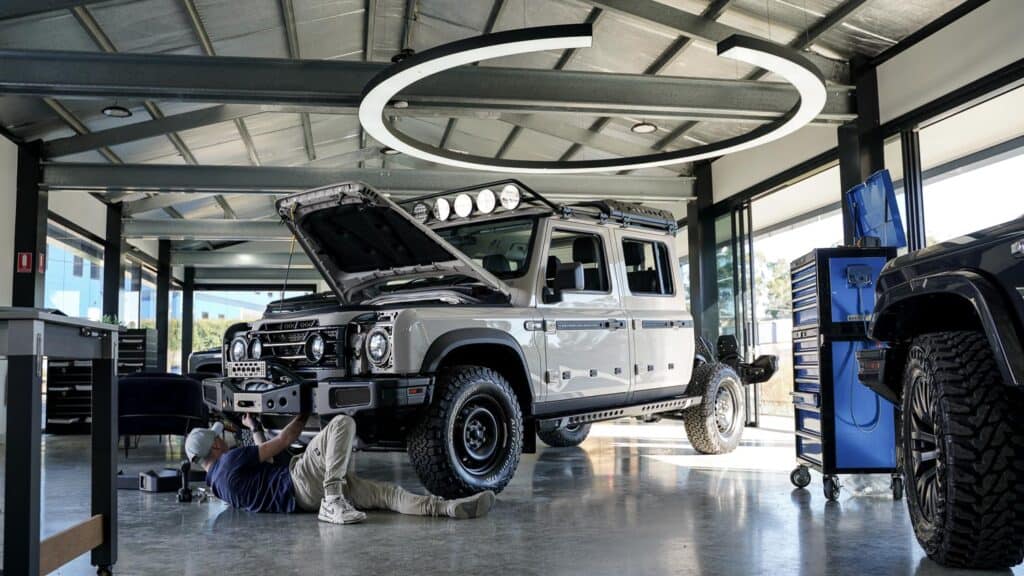
The drivetrain was a big part of the appeal. Our Quartermaster Trialmaster uses BMW’s 3.0-litre B57 turbo-diesel straight-six paired with the ZF eight-speed automatic. We specifically wanted the diesel. We like the torque characteristics for touring, the reputation and history behind the B57, and diesel still makes sense to us for the kind of long-distance travelling we’re planning. There’s also a personal connection. I worked for BMW earlier in my career, so I know the brand well. There’s something pretty cool about now building our Australian touring vehicle around a BMW straight-six diesel. And paired with the ZF eight-speed automatic, it’s a very different driving experience from our 79. For a vehicle that will now spend more time being driven around home as well as crossing Australia, that matters to us.
Comfort Matters More to Us Now
This was another lesson from the 79. You can tell yourself that comfort doesn’t matter in a 4WD — until you start spending thousands and thousands of kilometres in one. Our LandCruiser did exactly what we asked of it, but it was still fundamentally a 79 Series. A farm truck, designed for open-country dirt roads, not for highways or comfort.
The Quartermaster gives us coil suspension, a quieter cabin, RECARO seats and a much more modern driving environment. And we don’t see that as making the vehicle less of a 4WD. If anything, we like that INEOS has kept the mechanical foundations rugged while improving the parts you interact with every day.
When you’re spending eight or ten hours behind the wheel getting to the next destination, those things start to matter.
This Time, Less Is More
Probably the biggest philosophy behind our new build is:
We don’t need more. We need to use what we have better.
The camper is the perfect example. Our old 79 carried a Tommy Campers S6X. This time we’re moving to the smaller S4X. The S4X is 250mm shorter, which allows us to build the Quartermaster without the 300mm chassis extension we had on the LandCruiser. We’re also deleting the traditional tray headboard, allowing the camper to sit further forward. That gives us a shorter overall package and allows us to position more of the weight where we want it. But going smaller obviously means giving something up.
In our case, one of those things is 250mm of couch. After roughly 400 nights in the old camper, we realised something pretty funny: Sam and I hardly ever sat next to each other on the couch anyway. So why carry that extra length everywhere we go? That’s the kind of lesson you only learn by actually living with a setup for a long time.
We’re trying to apply those lessons everywhere in Bush and Bay 3.0.
Smaller where we don’t need the space. Better where we actually use it.
We’re Not Trying to Build a Smaller Camper With Less Capability
Going from an S6X to an S4X doesn’t mean we want to give up the things that make long-distance travel comfortable. We’ll still carry 150 litres of fresh water. We’ll still have a serious off-grid electrical system. It’s actually a better power system. We’ll still have hot water, a shower, diesel heating, induction cooking, Starlink, a proper fridge and plenty of storage. We’ve chosen Tommy’s Hybrid Kitchen to make better use of the smaller camper and give us kitchen access from inside.
So although the physical footprint is getting smaller, we’re trying to keep — and in some areas improve — the functionality that matters to us. That’s really the whole philosophy behind the vehicle.
What About Toyota’s Reliability and Support Network?
This was obviously something we had to think about. One of the biggest advantages of travelling Australia in a LandCruiser is that everybody knows what it is. Parts, workshops and knowledge are everywhere.
The INEOS Grenadier is a much newer vehicle and a much newer brand. We know we’re giving up some of that familiarity. That’s a compromise we’re going into with our eyes open. But we’re also not choosing the Quartermaster completely blindly. A lot of the major components come from established manufacturers, including the BMW engine and ZF transmission, and the vehicle itself has been designed around relatively traditional 4WD architecture.
Will that make it as easy to own in remote Australia as a LandCruiser? We don’t know yet. And we’re not going to pretend we do.
So, Is the INEOS Quartermaster better than an LC79 Series?
Ask us again after we’ve put 60,000 kilometres on it. Our LandCruiser earned our trust. We drove it around Australia, lived out of it for hundreds of nights and learned exactly what it could and couldn’t do.
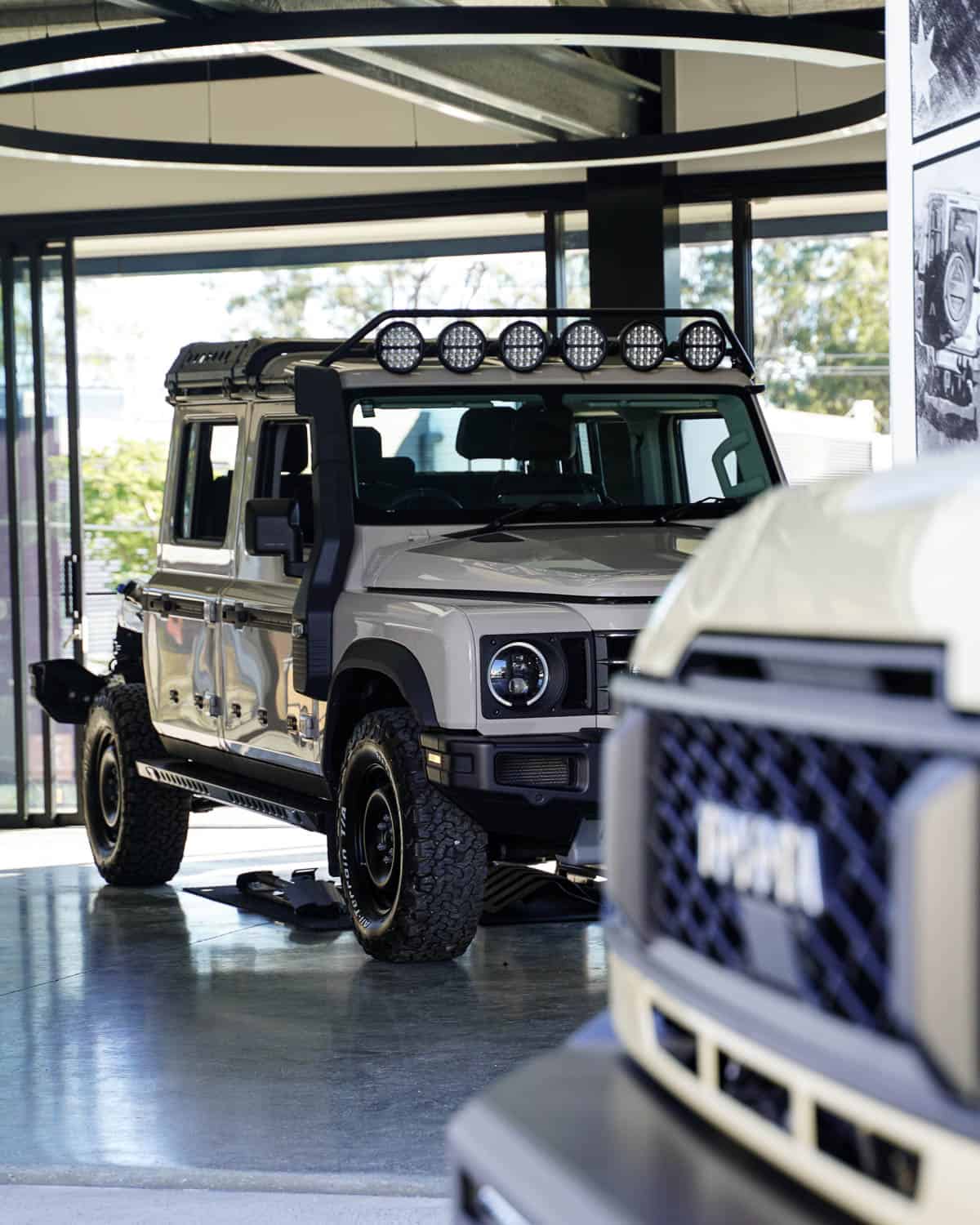
The Quartermaster hasn’t earned that yet. On paper, we think it’s a better fit for the way we want to travel now. It’s shorter. It’s more comfortable. The drivetrain is more modern. It should be more nimble on tighter tracks. And we can still build it around the same basic concept that worked so well for us: a capable 4WD carrying a Tommy slide-on camper. But a spec sheet doesn’t tell you whether a touring setup works. Travel does.
Bush and Bay 3.0 Starts Here
Our new Quartermaster will be very different from the vehicle that left the INEOS factory. It’s getting a JMACX 4.5-tonne GVM and suspension upgrade, Method Race Wheels, Toyo tyres, LeTech accessories, a custom Tommy Tray, Tommy Campers S4X, REDARC Power system and plenty more. The goal isn’t to build the biggest or most extreme INEOS Quartermaster. It’s to build the vehicle that makes the most sense for us, based on everything the last four years taught us.
Our first shakedown trip is planned for November 2026, followed by more extensive travel starting in early 2027. Then we’ll start finding out whether all those decisions were the right ones. For now, one thing is certain:
The 79 Series was the right vehicle for our last chapter. We think the INEOS Quartermaster is the right vehicle for the next one.
[Explore our complete INEOS Grenadier Quartermaster camper build →]