
Tasmania Road Trip Guide
Road Trip itineraries, free camping guides, hikes and travel guides.
The Ultimate Tasmania Road Trip Guide 2026
We spent ten weeks in Tasmania and didn’t see everything we wanted to.
That’s the most useful thing we can tell you about this island. It looks small on a map, a triangle hanging off the bottom of Australia, roughly the size of Ireland. And then you arrive and find the roads are slower than the distances suggest, the weather changes your plans twice a day, and every region has enough in it to fill a fortnight on its own.
But… It’s also the best camping we have done anywhere in Australia. And we have done a lot of it. More than forty campgrounds, beachfront free camps you cannot believe are free, rainforest, mountains, convict history and some of the emptiest coastlines in the country.
Almost a fifth of the island is national park or World Heritage wilderness. You can walk a 300-metre sea cliff in the morning and eat oysters off a jetty in the afternoon. And because it’s an island, nothing is more than about 1.5 hours from the coast.
This page brings you everything we’ve written about Tasmania in one place. Where to go, how long you need, what it costs, when to visit, and which guide you need to read next. All of it is from our own experience when exploring Tasmania. The campgrounds we stayed at, the walks we did, the fees we paid, and the mistakes we made so you don’t have to.
This is Tasmania.
A few of the links on this page are affiliate links. If you book through one, we earn a small commission at no extra cost to you, and it helps keep these guides free.


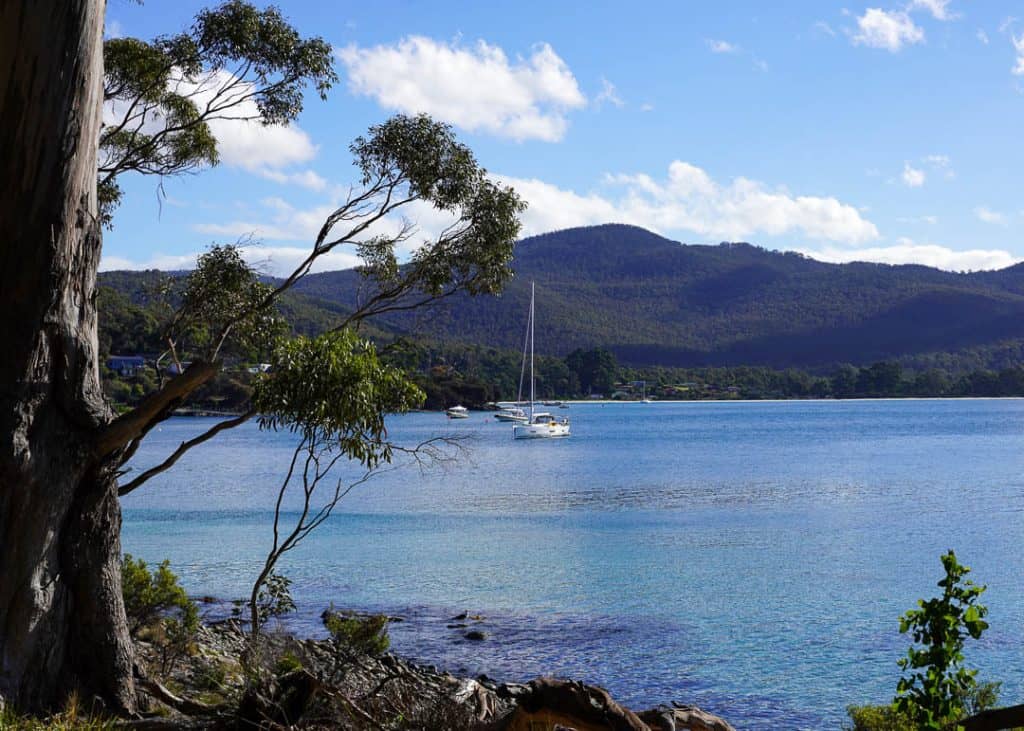
How to Travel Tasmania
Tasmania is about 68,000 square kilometres, which makes it roughly the size of Ireland and a little smaller than Sri Lanka. On paper, you could drive around the whole island in three days.
Don’t do this…. The roads here are narrow, winding and slower than the distances suggest. And the best of Tasmania sits at the end of a gravel road. Add about a third to whatever your phone tells you, and more for the West Coast.
Almost everyone does Tasmania by road, and that’s the right call. There’s no useful train and the bus network will not get you to a single campground on this page.
Getting there: The spirit of Tasmania
If you’re bringing your own car, caravan or camper trailer, The Spirit of Tasmania is the only way across. It sails from Geelong (not Melbourne) and Devonport on the north coast of Tasmania. The crossing takes around eleven hours.
The ferry changes completely on 31 October 2026
Spirit of Tasmania I and II make their final crossing in late October. From 31 October 2026, the two new ships, Spirit of Tasmania IV and V, take over. Much bigger, with more room for caravans, motorhomes and tall vehicles.
There’s no paying passenger service between 23 and 30 October 2026 while crews are trained and the new ships are tested. Day sailings are being discontinued, so the overnight crossing is what you get. If you have travelled the Spirit before, don’t assume anything.
Three things to know before you go:
- Book 4 to 6 months ahead for summer. Vehicle spaces sell out long before passenger seats do.
- Measure your vehicle. The standard height limit is 2.1 metres, and a rooftop tent, boards or a loaded roof rack will push you over it.
- Book the ferry before anything else.
Flying instead
You can fly into Hobart, Launceston, or Devonport and hire a campervan or 4WD, paying between $55 and $120 per day, depending on the season and size. For a trip about 10 days or less, flying and hiring often works out cheaper than two ferry fares. For anything longer, or if you have a setup you want to travel with, take your own.

Where are you going?
Tasmania breaks into six regions, and we’ve written a full guide to most of them. Click through to the one you’re heading for.


How long do you need in Tasmania
More than you are planning. Everyone underestimates this one, because the map looks manageable.
A long weekend
You can do one region, for example the Tasman Peninsula from Hobart or Cradle Mountain and the north-west from Devonport.
One Week
One loop, and you’ll have to choose a side.
- The Western Side: Cradle Mountain → Strahan → Queenstown → Western Explorer → Stanley
- The Eastern Side: Bay of Fires → Down the coast
➤ If you’re looking for a one-week itinerary, check out our 7-day Island-Wide Tasmania Itinerary or if you’re planning on exploring the western side, here’s our 7-Day West Coast Tasmania Itinerary.
10 Days
The 7-day loop plus Bruny Island.
Two Weeks
Both coasts at a proper pace, with Bruny, and time to sit still for a day when the weather turns.
Three weeks or more
Add Corinna and the Western Explorer, the far south at Cockle Creek and the north-west around Stanley.
Region by region
If you’d rather plan by region, here’s what we’d suggest:
The best way to travel Tasmania
You do not really need a 4WD in Tasmania. Unlike most of mainland Australia. Everything is very accessible. But as usual, we had the best time on the unsealed Western Explorer, which is 2WD-accessible in dry conditions, but a bit of clearance was necessary.
Every region on this page has a 2WD version. Most of the best places can be reached by 2WD. What you do want to check are the conditions if you’re renting a car. Some car rental companies don’t allow you to go on unsealed roads.
Three things you should keep in mind when exploring Tasmania:
- Don’t drive at dawn, dusk or after dark if you can avoid it. Tasmania has so much wildlife and most of it is nocturnal.
- Fuel up at half a tank, not when you’re low. Especially on the West Coast.
- Check your hire agreement before you take gravel.
Best time to visit Tasmania
We found February to April the best time to travel to Tasmania. The water is at its warmest (still fresh though), the summer crowds have gone home, and the conditions are ideal for hiking. Also, for nature lovers, the fagus turns gold at Cradle Mountain in late April. This is Australia’s only native deciduous tree, and it’s worth planning a trip around if this is of interest to you.
|
Season |
What it’s like |
Best for |
|---|---|---|
|
Summer (Dec-Feb) |
Warmest, longest days, everything open. Also the busiest and most expensive. Book the ferry six months out and enter the Freycinet Ballot. |
Swimming, Bay of Fires, long daylight for walking |
|
Autumn (Mar-May) |
Our choice. Warm water in March, fewer crowds and the fagus turning in late April. |
Camping, hiking, Cradle Mountain |
|
Winter (Jun-Aug) |
Cold, wet and wild. Snow is closing some alpine tracks. The West Coast is at its most dramatic, with empty campgrounds. |
The West Coast, Hobart, aurora |
|
Spring (Sep-Nov) |
Wildflowers through the heath, improving walking conditions, and the biggest swells of the year. Changeable. |
Walking, wildlflowers, Shipstern Bluff, whale watching |
Whatever month you go, pack for cold. The four seasons in a day is not a cliché in Tasmania. Bring something waterproof, windproof, a warm mid-layer, and proper walking shoes.
Whales pass twice a year: Humpbacks head north between May and July and come back south between September and November. Pirates Bay on the Tasman Peninsula and the East Coast headlands are good places to watch from.
Driving distances in Tasmania
Measured from Devonport, where the ferry arrives. Times assume you don’t stop, which you will.
|
Destination |
Distance |
Driving time |
|---|---|---|
|
Cradle Mountain |
~85 km |
1 hr 25 |
|
Launceston |
~100 km |
1 hr 15 |
|
Stanley |
~140 km |
1 hr 45 |
|
Strahan (via Tullah) |
~250 km |
3 hr 15 |
|
Bay of Fires (Binalong Bay) |
~265 km |
3 hr 15 |
|
Freycinet (Coles Bay) |
~270 km |
3 hr 15 |
|
Hobart |
~280 km |
3 hr 15 |
|
Kettering (Bruny Island Ferry) |
~315 km |
3 hr 45 |
|
Port Arthur |
~375 km |
4 hr 30 |
|
Cockle Creek |
~440 km |
5 hr 30 |
And from Hobart, if you’re flying:
- Port Arthur: 1 hr 15
- Kettering: 35 min
- Coles Bay: 2 hr 30
- Launceston: 2 hr 15
- Cockle Creek: 2 hr 30
- Cradle Mountain: 4 hrs
- Strahan: 4 hr 15
→ Nothing in Tasmania is more than about 5.5 hours from anything else.
What does a Tasmanian Road Trip cost?
Tasmania is probably one of the cheapest places in Australia to travel if you camp.
|
Cost |
Amount |
|---|---|
|
Parks Pass – 2 month holiday vehicle pass |
$98.35, up to 8 people |
|
Parks Pass – daily vehicle |
$49.15 |
|
Cradle Mountain Day Icon Pas (separate, includes the shuttle) |
#30.70 per adult | $12.30 per child | $73.75 per family |
|
National Park Camping |
$13 per night for two people | $16 powered |
|
Free Camping |
$0 |
|
Port Arthur Historic Site |
$55 per adult | $27.50 per child |
|
Campervan hire |
Roughly $55 – $120 per day |
|
Caravan Parks |
Roughly $35 – $55 per night |
TIP: Buy the 2-month holiday pass rather than daily passes. Two daily passes already cost more, and almost every trip visits more than two parks. The one thing to know is that it does not cover Cradle Mountain, which has its own separate Icon Pass.
➤ Full details on fees, passes, and the three different booking systems are in our camping in Tasmania guide.
What to pack for Tasmania
We won’t give you a massive list, only what made the most difference to ten weeks on this island, and why:
- Layers and a proper waterproof jacket: The 4 seasons in a day are not a lie. Pack accordingly.
- A heated blanket: When camping without a diesel heater, this can be a game-changer.
- A proper hat: The ozone layer is thinner down here, and the UV is fierce, even when it’s cold. With the wind, you won’t even notice that you’re burning. We wear our Will & Bear hats, which are UPF 50+. Use the code BUSHANDBAY at checkout to get 10% off your entire order.
- Enough drinking water for every walks
- SURVIVAL first aid kit: Especially when you plan to hike, a snake-bite kit or a compact hiking first aid kit is not a luxury. Get 10% off selected collections when using the code BUSHANDBAY.
- Offline maps downloaded before you leave Devonport.
- A Muk Mat at the door of your camper or caravan to keep the gravel and sand out of the camper. Get $10 off with code BUSHANDBAY.
Plan your trip to the East Coast
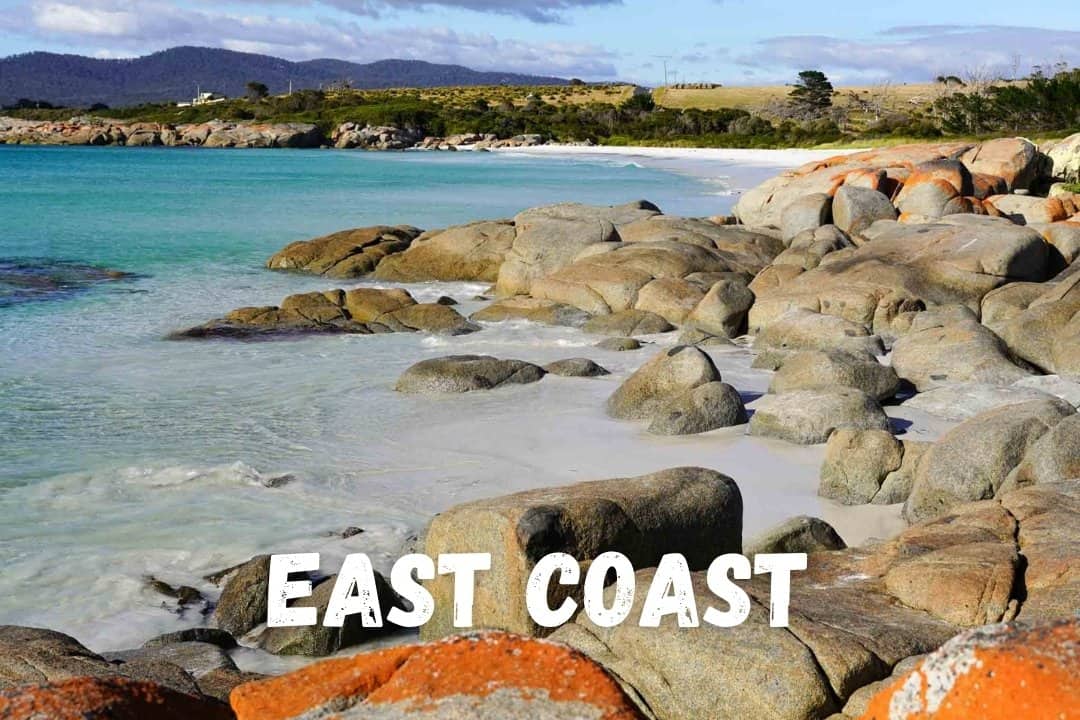
The East Coast is the most popular side of Tasmania, and you’ll quickly figure out why.
The Great Eastern Drive runs past one white beach after another, through charming coastal towns, up to the famous Bay of Fires and through Freycinet National Park with Wineglass Bay at the end of it. It also has the best free camping in Australia. Beachfront sites, million-dollar views, no bookings, no fees, and at the Bay of Fires, no parks pass either.
When you first see the orang granite boulders against the turquoise water, you genuinely cannot believe it’s free.
➤ Start with our complete guide to camping on the East Coast of Tasmania, all eight Bay of Fires campgrounds, the Freycinet ballot and a free map.


Best time to visit the East Coast
February and March for the warmest water and the best beach days. April is quieter, and the light is beautiful. Over Christmas and January, the Bay of Fires campgrounds fill by mid-morning and the Freycinet ballot applies. This is not a coast to turn up to on spec in summer.
How long do you need on the East Coast
Two days get you Freycinet or the Bay of Fires, not both. Four days does both in a rush. Ten days to two weeks is what this coast actually deserves, because the whole point of it is stopping.
Things to do on the East Coast
Two things worth booking ahead on this coast are:
Camping on the East Coast
There are 8 free campgrounds at the Bay of Fires; none of them is bookable. All are first-come, first-served. Freycinet runs a summer ballot for Richardsons Beach, Honeymoon Bay and Ranger Creek, with entries opening months ahead. It’s the single biggest obstacle between a December traveller and a campsite on this coast.
If you miss the ballot, Friendly Beaches is 26 km north and free with a parks pass. And there’s plenty of accommodation in Coles Bay if you would rather have a roof over your head for a night or two.
Explore the Tasman Peninsula
An hour from Hobart, and most people give it a day. That’s a mistake. It was our favourite region in Tasmania.
It’s a small place. You can drive from one end to the other in 40 minutes. And somehow, it holds the tallest sea cliffs in the Southern Hemisphere, two of the best day walks in the country, a World Heritage convict site, and a rock platform that looks like someone tiled it by hand.
➤ Everything is in our Tasman Peninsula Guide: things to do, the cape walks, Port Arthur and where to camp.


Best time to visit the Tasman Peninsula
February to April. Warm enough to swim at Fortescue Bay, ideal conditions to hike the capes, and less crowds once the school holidays end.
How long do you need on the Tasman Peninsula?
Three days is the sweet spot. One for Eaglehawk Neck and the north, one for Cape Hauy, one for Port Arthur and the south. Five if you want to walk both capes and still have time to relax (or recover).
Things to do on the Tasman Peninsula
Camping on the Tasman Peninsula
Two national park campgrounds, both $13 per night for two people plus a parks pass. Fortescue Bay sits behind a white beach with the Cape Hauy trailhead starting at the campground. Book it between October and April. Lime Bay is quieter and first-come, first-served. With a 45-minute walk to a beach you can’t reach any other way.
There’s no free camping on the Tasman Peninsula. If you’d rather not camp or you’re travelling with a dog, see what’s available around Port Arthur and Eaglehawk Neck.
Explore Bruny Island
A short vehicle ferry from Kettering, 35 minutes south of Hobart, and it feels like a different country.
Two islands joined by a narrow neck with a penguin rookery underneath it and a staircase to a lookout over both. White wallabies, found almost nowhere else. The Fluted Cape walk. A lighthouse at the southern end, and some of the best food in Tasmania: cheese, oysters, chocolate and a bread fridge you pay for with an honesty system.
➤ Read our full guide to Bruny Island with all campgrounds, the ferry and a 4-day itinerary.


Best time to visit Bruny Island
Autumn for quieter campgrounds. Summer for the warmest water and the longest days. But the ferry queue on a January morning is its own experience.
How long do you need on Bruny Island?
Three days minimum, five if you want to do the walks and the food properly. It doesn’t fit in a one-week Tasmania trip; it’s the first thing we would add and it would make it ten days.
Things to do on Bruny Island
Camping on Bruny Island
Four campgrounds, and the free one is really good.
- The Neck Reserve puts you five minutes from the lookout, which is the whole reason to be there for sunrise.
- Jetty Beach is off-grid and close to the lighthouse.
- Cloudy Corner is 4WD-only.
- The Pines: free with a parks pass
➤ Full comparison and the ferry costs in our guide to Bruny Island.
Explore the West Coast
The Wild West. And the region most people skip.
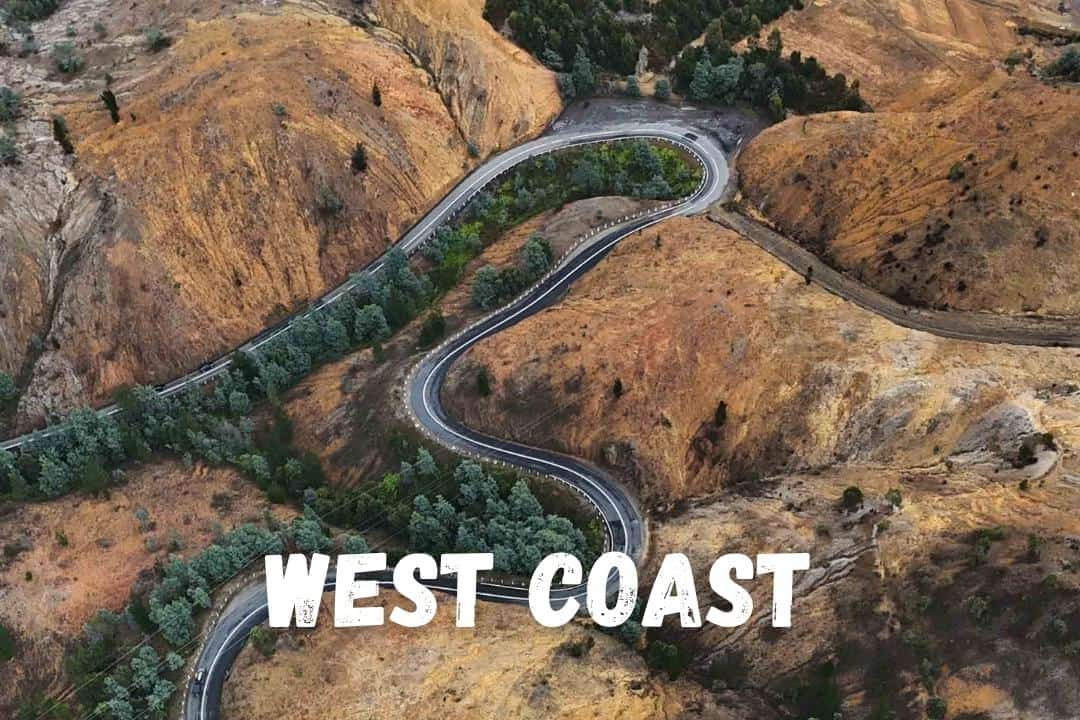
Mining towns, button grass plains, rainforest and rain. This is the last place the Tasmanian tiger was seen, and it’s raw. The drive into Queenstown over the 99 Bends takes you through hills stripped bare by a century of copper smelting. Bright orange, grey and pink, folding away in every direction. It looks like Mars. It is unsettling and completely unforgettable.
Strahan sits on a harbour six times the size of Sydney’s, and Ocean Beach is 40 kilometres of sand facing the Southern Ocean with nothing between you and Argentina.
➤ Our guides: camping on the West Coast for the free camps town by town, and a 7-day West Coast Itinerary for the whole route.


Best time to visit the West Coast
Summer and autumn are the best chance of clear weather. But the coast is at its most dramatic in bad weather. Winter is cold, wet and almost empty.
How long do you need on the West Coast?
One week for the itinerary above. Two if you want to properly explore Corinna, the Western Explorer and Tarkine.
Things to do on the West Coast
Camping on the West Coast
Some of the best free camping on the island! Granville Harbour on the beach and Mersey Forest by the lake.
If you want to stay in town and are looking for a shower or maybe a roof over your head for a night or two, there’s accommodation in Strahan.
Explore Cradle Mountain and the Central Highlands
Dove Lake sitting underneath those two jagged peaks in the photograph everyone has seen of Tasmania, and it looks exactly like that in real life, which is rarer than it should be.
There are more than twenty walks here. From ten minutes to six days, and the northern end of the Overland Track. The wombats do not care about you, and are out and about.

Know before you go: How Cradle Mountain Access Works
Most importantly: you cannot drive your own vehicle to Dove Lake during shuttle hours.
Private vehicles are not permitted into that part of the park while the shuttle is running, and there are only nine parking spaces at Dove Lake outside those hours.
You park at the Visitor Centre and take the shuttle in. Hours are seasonal, roughly 8:30 am to 4 pm in winter and 8 am to 5:30 pm in summer.
Cradle Mountain has its own pass: The Day Icon Pass. $30.70 per adult, $12.30 per child, or $73.75 for a family, including the shuttle. Your standard Tasmanian Parks Pass does not cover it.
The walks at Cradle Mountain
|
Walk |
Distance |
Time |
Grade |
|---|---|---|---|
|
Rainforest Walk |
431 m |
10 min |
1 |
|
Weindorfers Forest Walk |
750 m |
20 min |
2 |
|
Enchanted Walk |
1.1 km |
20 min |
2 |
|
Crater Lake |
5.7 km |
2 hrs |
3 |
|
Dove Lake Circuit |
6 km |
2-3 hrs |
3 |
If you only do one, do the Dove Lake Circuit. All the way around the lake, mostly boardwalk, and it gives you the mountain from every angle, including the boatshed.
Where to stay at Cradle Mountain
There’s no free camping at Cradle Mountain. The closest free camp is located in Tullay, about 45 minutes south-west.
There are options within the park boundary, but they’re limited and book out months in advance. See what’s available at Cradle Mountain.
Other parts of Tasmania worth knowing about
The Far South and the Southwest
Tasmania’s wildest and least accessible corner, and the one part of this page we have not properly done ourselves yet. So it’s more a recommendation.
Cockle Creek is the southernmost point in Australia you can drive to, about two hours south of Hobart via Huonville, Geeveston and Ida Bay. The last stretch after Ida Bay is gravel but manageable in a 2WD, a campervan, or with care when towing a caravan.
From there, the South Cape Bay walk runs 18 kilometres return, about four hours, out to a beach facing the Southern Ocean with nothing beyond. There are toilets at each campground, and a water tank at Boltons Green that needs to be boiled. It’s a fuel-stove-only area; fires are prohibited. And a parks pass is required.
Hobart
Small enough to walk, interesting enough to give it three days.
- Mount Wellington is a drive to a 1,271-metre summit with the whole south-east laid out below you. It’s brutally cold up there, even in summer.
- Salamanca Place on a Saturday is one of the best markets in the country.
- MONA is the reason a lot of people visit Hobart. Built into a cliff, half underground and deliberately provocative. Take the ferry rather than driving.
Accommodation in Hobart is the one night of most trips where a real bed makes sense.
The north-west and Stanley
The Nut is an old volcanic plug rising straight out of the sea with a town at the bottom of it.
Launceston and the Tamar Valley
Cataract Gorge is a river gorge with a chairlift and a swimming pool inside the city limits, and it’s free. The Tamar wine route runs north from there.
Flinders Island and King Island
Both in Bass Strait, both requiring a flight or a very different ferry.
The Overland Track
Six days from Cradle Mountain to Lake St Clair, booked and permitted, and one of the great walks in the world.
Camping in Tasmania
This is what we came for, and the reason we stayed for ten weeks. Tasmania has a few systems for where you sleep. Here’s an overview:
- Free camping: our favourite, widespread and often beachfront. Well over a hundred designated free camping areas.
- National Park Camping: $13 per night for two people plus a parks pass per vehicle. Basic, but great located.
- The Freycinet Ballot: runs for the summer peak and is the single biggest obstacle.
- Caravan parks: they fill the gaps, roughly between $35 and $55 per night.
What we’ve learned
➤ How it all works: Camping in Tasmania: Free Camps, fees and parks passes
Where to stay in Tasmania if you’re not camping
Not everyone enjoys camping, and sometimes, after a few days of hiking and free camping, we’re happy to have a long shower and a proper bed.
Tasmania does shacks and cabins better than anywhere. Small, old, off-grid, and often part of the Tasmanian experience.
Have a look at what’s available across Tasmania. And book earlier than you think for anything between December and February.
Tours worth booking ahead
We are not big tour people, but these are the four that are worthwhile when you’re there, and they’ll get you somewhere you can’t reach by car or foot:
- The Gordon River Cruise in Strahan: deep into World Heritage Rainforest
- Tasman Peninsula Wilderness Cruise: along the base of the highest sea cliffs in the Southern Hemisphere
- The Bruny Island Wilderness Tour: a coastline you can’t see from the road
- The Wineglass Bay Tour from Coles Bay: into the bay itself, without the climb.
Tips for planning a Tasmania Road Trip
Tasmania FAQs
Where is Tasmania?
Tasmania is an island state of Australia, about 240 kilometres south of the mainland across Bass Strait, below the state of Victoria. It covers roughly 68,000 square kilometres — about the size of Ireland — and Hobart, the capital, is around an hour by air from Melbourne.
How many days do you need in Tasmania?
Seven days is enough for one good loop but not for the whole island. Ten days lets you add Bruny Island, and fourteen lets you do both coasts properly. By region, allow 10 to 14 days for the East Coast, 5 to 7 for the Tasman Peninsula, 3 to 5 for Bruny Island, one to two weeks for the West Coast and 3 to 5 days for Cradle Mountain.
What is the best time of year to visit Tasmania?
February to April. The water is warmest in February and March, the weather is more settled than in spring, the summer crowds have gone, and the fagus turns gold at Cradle Mountain in late April. Winter is cold and wet but dramatic, and the campgrounds are empty.