
Camping on Bruny Island: Free camps, ferry & 4-Day itinerary

Last updated: September 2026
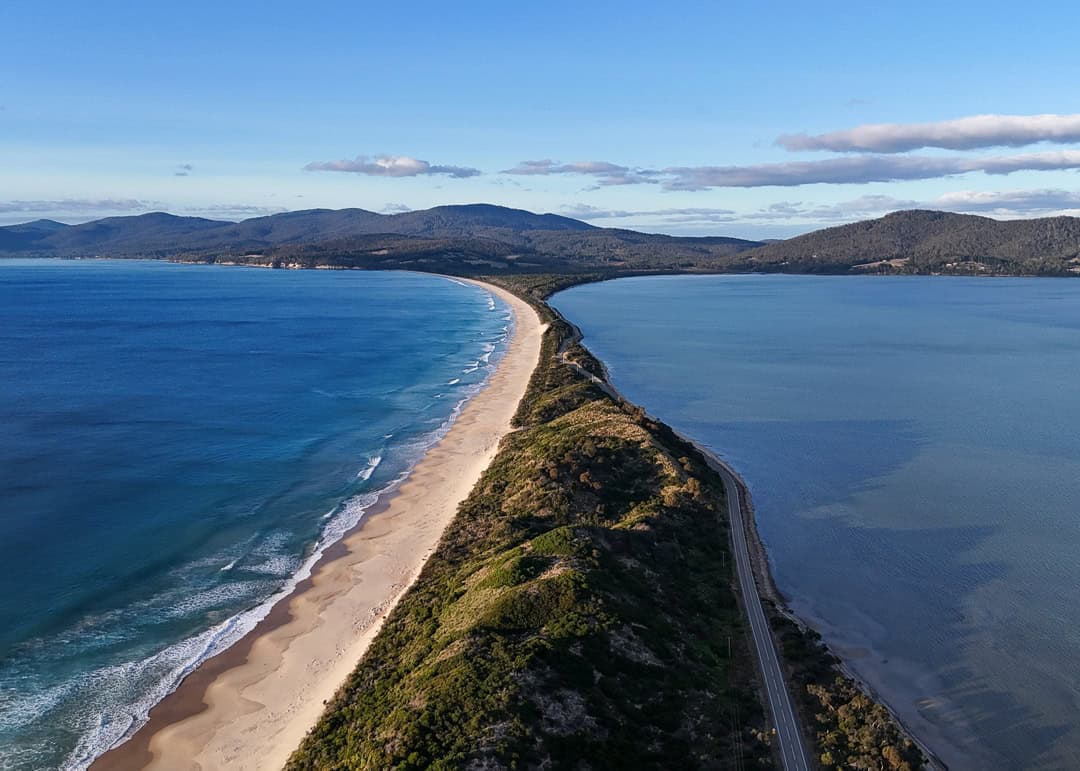
Bruny Island sits off the southern end of Tasmania, an hour from Hobart and a twenty-minute ferry ride from a little town called Kettering. It is two islands, really, joined by a narrow sandy neck, and the moemnt you drive off the ferry, it feels like somewhere much further away than it is.
We spent four days camping on Bruny Island, and it was one of the highlights of our ten weeks in Tasmania. Two of our three favourite campgrounds in the whole state are on this island, and they only cost $10 per night.
This guide covers all four campgrounds, what each one costs, free camping, how the ferry works, the walks worth doing and a four-day itinerary you can follow.
➤ If you’re heading to Tasmania, start with our complete guide to Camping Tasmania, which includes information on park passes, fees, the ferry, and when to go.
Where is Bruny Island Located?

Bruny Island is located at the Southern End of Tasmania, Australia, about an hour away from Hobart. You can reach Bruny Island via a 20min vehicular ferry that crosses from the little town of Kettering, which is a 30min drive (32km) southwest of Hobart.
The Bruny Island Ferry
This is the first thing you need to know, and it’s simpler than you’d expect.
Where it goes from
The ferry leaves from Kettering, about 30 minutes and 32 kilometres southwest of Hobart, and lands at Roberts Point on the northern end of Bruny. The crossing runs across the D’Entrecasteaux Channel and takes 15 to 20 minutes.
How often
It is operated by SeaLink under contract to the Tasmanian Transport Commission, with two modern vessels running a high-frequency timetable. As often as every 20 minutes at peak times.
Bookings
You cannot book a specific departure. It works an a queue at the terminal. You buy a ticket online in advance or at the booth when you arrive, then join the line and take the next boat with space.
All tickets are return fares, and a ticket is valid for 365 days from the date of purchase. So if you buy your ticket online and your plans change, you haven’t lost it.
What it costs
Fares are worked out by vehicle type and length, which is the bit that might surprise you when towing. It goes up with overall length. Pedestrians travel free. If you are cycling or walking on, you pay nothing.
Fares change on 28 September 2026, so we have deliberately not published any information that will be out of date within a few weeks. Check the current fares on the SeaLink Bruny Island site before you go.
Know before you go

Can you free camp on Bruny island?
Yes, you can go free camping on Bruny Island! The best free camp we’ve found on Bruny Island is The Pines near Cloudy Bay. It’s a small site with pit toilets and is a great place for surf enthusiasts.
Everywhere else, it’s either $10 per night for two or a caravan park.
→ The Pines: Located on Cloudy Bay Road in South Bruny National Park. It’s a small campground with pit toilets and tank water. It’s free, but… you still need a park pass to enter the national park. It’s a five-minute walk to the surf at Cloudy Bay, which makes it the pick if you have boards with you and no 4WD.
The other three are not free, but they’re low-cost. Cloudy Corner and Jetty Beach are $10 for one or two people, or $15 for a family with three children. That is the cheapest national park camping in Tasmania.
The Neck Reserve is $10 to $15 and needs no park pass, because it sits outside the national park boundary. If you’re only staying one night and not going into the park at all, this is the cheapest way to sleep on Bruny Island.
What you can’t do is camp on the beaches, in the car parks, or anywhere that is not a designated campground. Bruny is small; the rangers know it well, and the four campgrounds are good enough, so there’s no reason to try.
All four bruny island campgrounds compared
|
Campground |
Cost |
Parks Pass |
Access |
Facilites |
|---|---|---|---|---|
|
Cloudy Corner |
$10 for 2 – $15 family |
Yes |
4WD, beach driving at low tide |
Pit toilets, tank water, fuel stove only |
|
Jetty Beach |
$10 for 2 – $15 family |
Yes |
2WD gravel |
Pit toilets, tank water, picnic tables |
|
The Pines |
Free |
Yes |
2WD |
Pit toilets, tank water |
|
The Neck Reserve |
$10 – $15 |
No |
2WD |
Pit toilets, tank water, picnic facilities |
|
Captain Cook Holiday Park |
Paid, from around $35 |
No |
2WD |
Powered sites, cabins, showers, dog-friendly |
None of the four campgrounds takes bookings. They’re all first in, first served, use a self-registration box, and you want cash. Jetty Beach has taken cards at times, but don’t rely on it.
The holiday park can be booked upfront, but book in advance to avoid disappointment. Especially in peak season.
Cloudy Corner – Our favourite campground in Tasmania
Cloudy Corner sits at the far eastern end of Cloudy Bay in South Bruny National Park, and getting there is half the adventure. You drive about three kilometres along the sand; you need a 4WD and a low tide to do it. Check the tide before you go, and check it again before you plan to come out.
Cloudy Corner is a big, spacious campground with plenty of secluded corners, decent shade, and sites overlooking the calm water at the sheltered end of the bay. It’s a great spot for paddleboarding, kayaking, fishing and launching a boat.
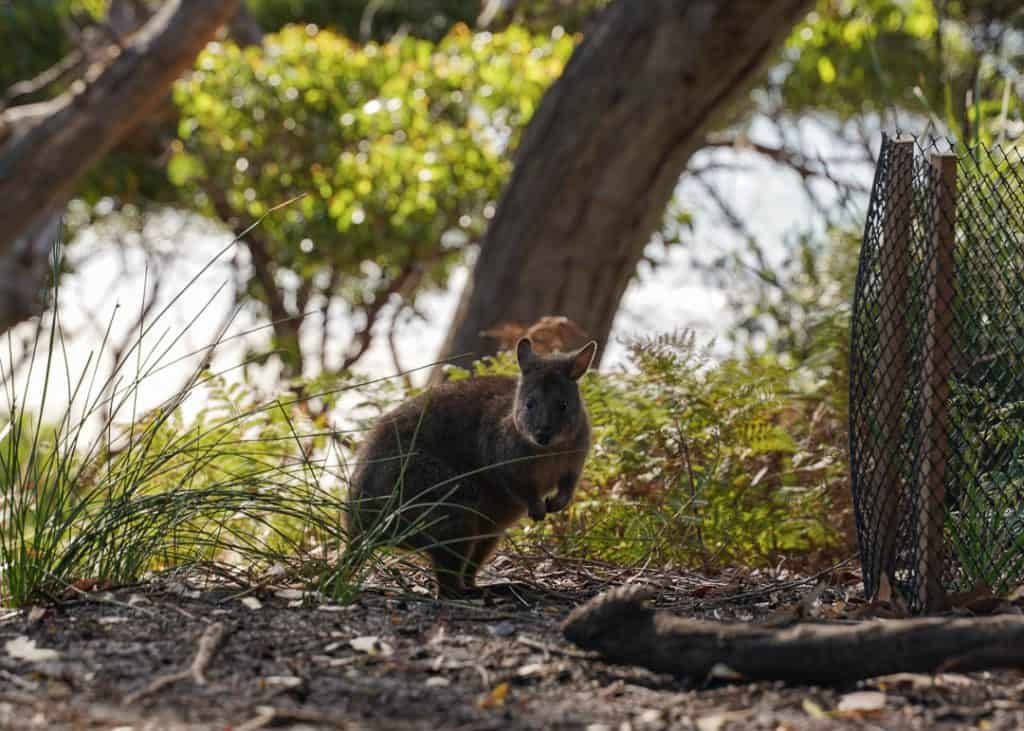
There is wildlife everywhere, and the local wallabies are entirely unbothered by people. We had some wallaby food left from earlier in our trip, and one adopted us for the evening. We called him Wally, which tells you how much thought went into it.
Keep in mind that Cloudy Corner is a fuel stove-only area. No wood fires, no charcoal at any time of year. Gas is fine.


Jetty Beach – 2WD accessible
$10 for two people ($15 family) plus a parks pass. Pit toilets, tank water and picnic table. 2WD gravel.
Jetty Beach is tucked away on the southern tip of the island, and it was probably our favourite site of the four. It is 2WD-accessible and still feels remote, which is a rare combination.
The camping area backs straight onto Jetty Beach itself, a sheltered, protected bay that is perfect for launching a paddleboard, a kayak or a boat, or just going in for a swim without the swell you get on the exposed side of the island. The water is calm here when everywhere else is not.
Two walks start from the campground:
- The Luggaboine Circuit: About 5 km and 2.5 hours. Easy, through coastal bushland and it brings you to a secluded beach.
- The Labillardiere Peninsula Circuit: 18 km, 5.5 to 6.5 hours, grade 4. This is the big one, and it takes you to the remote corners of the island.
Cape Bruny Lighthouse is a five-minute drive. It first shone in 1838, and it is Australia’s second-oldest surviving lighthouse tower. Guided tours run daily, and the view down the channel from the top is worth the ticket.


The Neck Reserve
$10-$15 per night. No parks pass required. Pit Toilets, tank water, and picnic facilities; 2WD accessible.
The Neck Reserve sits on the narrow isthmus that joins north and south Bruny, which makes it the most central place to stay on the island. Sites are spacious, there is beach access straight off the campground, and you are five minutes from the island’s best-known view.
It sits outside South Bruny National Park, so you don’t need a parks pass here. That’s worth knowing if Bruny is a short stop rather than part of a longer trip to Tasmania.
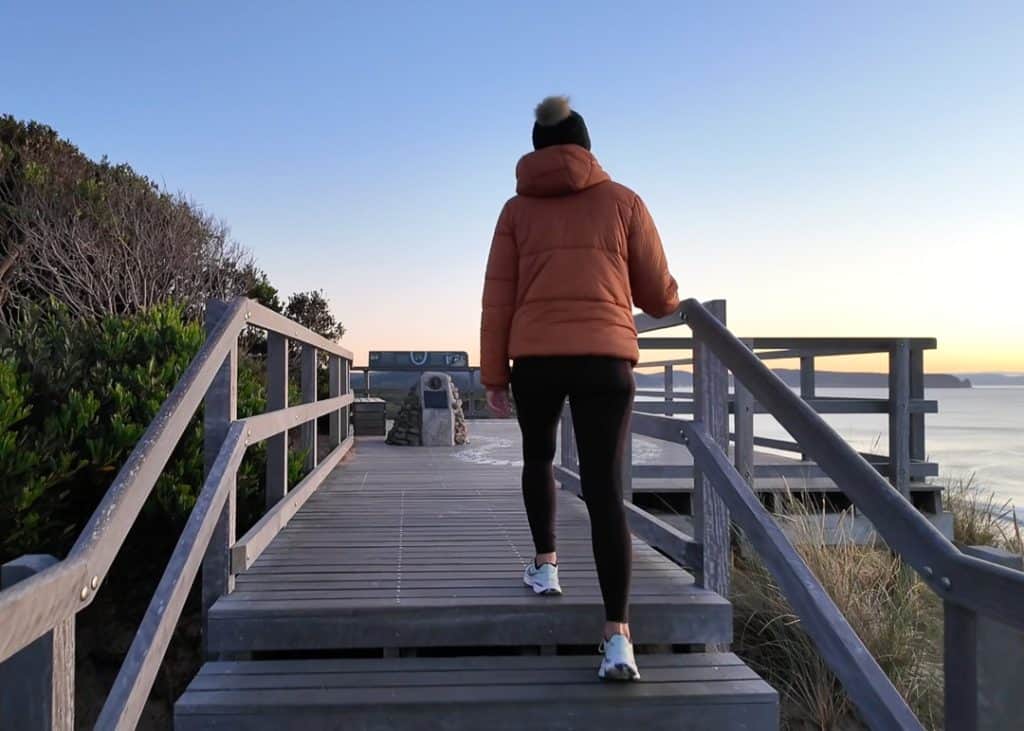
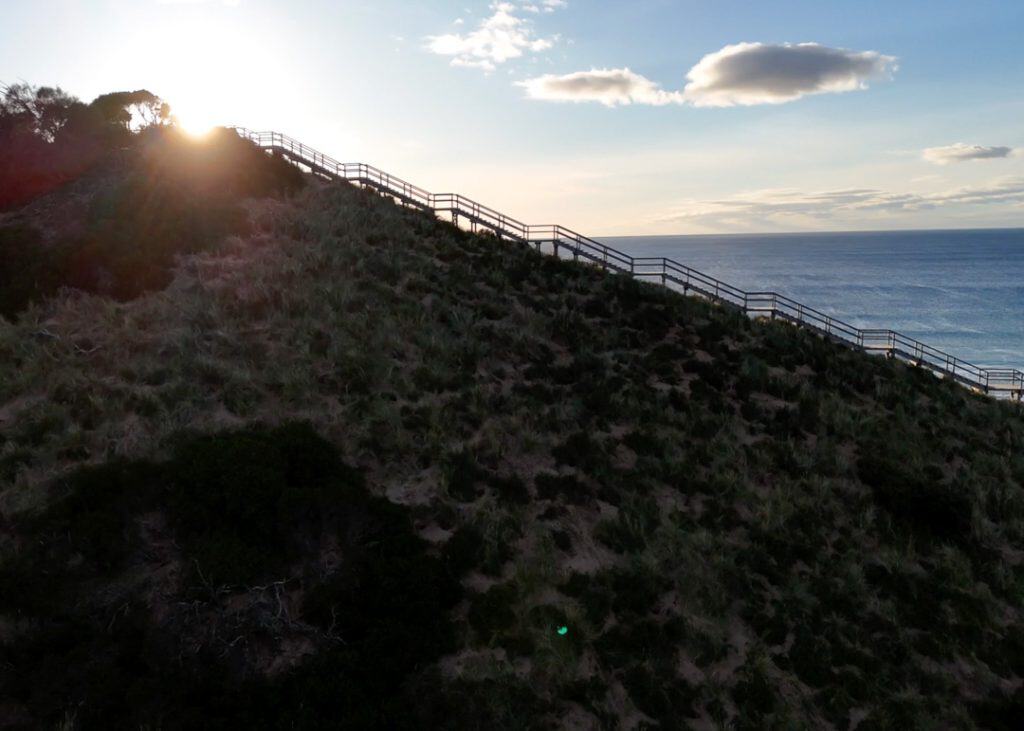
The Truganini Lookout is the reason to stay. It’s a short walk, about 300 metres and 15 minutes, but it’s close to 300 steps up the dunes. But the view from the top is absolutely worth it. It’s the photo everyone takes on Bruny Isalnd.
TIP: Go at sunrise. It’s the busiest spot on the island by mid-morning and at sunset. But completely empty for sunrise. You’re only 5 minutes from the campground, so there’s no excuse.
Underneath the lookout, there is a rookery where little penguins and short -tailed shearwaters come ashore to their burrows in the dunes at dusk. Best viewing is from September to February. Watch from the boardwalk, and keep torches and camera flashes off them. The light disorients the birds, and they will not come in.


The Pines – The free one
Free with a parks pass. Pit toilets and tank water. 2WD accessible.
A small campground on Cloudy Bay Road, on the same bay as Cloudy Corner but reachable without a 4WD. It’s free, and a short walk to the surf.
Caravan parks Bruny Island
If you want power, a shower, or a site you can book ahead, there’s one obvious answer on Bruny Island.
Captain Cook Holiday Park – Adventure Bay
Powered and unpowered sites, cabins, amenities and a very good location at Adventure Bay on the east coast of South Bruny. Walking distance to the beach and a short drive to the Fluted Cape walk.
It’s also the dog-friendly option on the island. It’ll cost more than $10 per night, but if you’re travelling with a dog or with young kids, it’s worth it for the showers alone.
If you don’t feel like camping, there are cabins and other accommodations available.
Can you take a caravan to Bruny Island?
Yes, and plenty of people do it. But there are things to keep in mind:
- The ferry charges by vehicle length.
- Cloudy Corner is out. Jetty Beach, the Neck and the Pines are fine.
- The roads south of Alonnah are narrow and partly unsealed.
If your setup is large, the honest answer is that the Neck Reserve and Captain Cook Holiday Park are your two comfortable options. And both have a great location to set up as a base and explore from there.
A 4-Day Bruny Island Itinerary
This is roughly how we did it, tightened up with what we would change. It assumes you have a vehicle and are camping. If you have a 4WD, do it as written. If not, swap Cloudy Corner for the Pines, and everything else should still work.
Day 1 – the Neck
- Cross from Kettering in the morning. 15 to 20 minutes.
- Drive north on Bruny first while everyone else drives south. Dennes Point at the top of the island is quiet and pretty, and almost nobody goes here.
- Stop at the Bruny Island Cheese Company, and pick something up for the next few days. The bread fridge run by the Bruny Baker is an honesty-box roadside fridge with fresh sourdough. It’s a lovely thing to see, but it gets busy and sells out quickly.
- Set up at the Neck Reserve
- Sunset at the Truganini Lookout, then stay for the penguins coming in at dusk if you are here between September and February.

Day 2 – South Bruny, the lighthouse and Jetty Beach
- Watch the sunrise at the Truganini lookout. Five minutes from camp.
- Pack up camp and head south. Stop at Alonnah for anything you need.
- Set up camp at Jetty Beach.
- Cape Bruny Lighthouse in the afternoon. Five-minute drive from camp, tours run daily.
- Swim, paddle or kayak at Jetty Beach in the late afternoon/evening.

Day 3: Hike and relax
- The big option: The Labillardiere Peninsula circuit: 18 km and 5.5 to 6.5 hours, straight from the campground.
- The slower option: The Luggaboine Circuit, about 5 km and two and a half hours.
- If you have time and the tides are right, drive across to Cloudy Bay in the afternoon to set up camp. If you’ve done the long hike, relax at Jetty Beach and stay another night.

Day 4: Cloudy Corner, Adventure Bay and Fluted Cape
- If you travel with a 4WD, and didn’t come up the day before, head to Cloudy Corner and stay for another night.
- If you don’t have a 4WD, spend the day at Adventure Bay on the east coast. The beach is beautiful and the Fluted Cape walk starts from there.
- Fluted Cape is 4 km, about 2.5 hours return, grade 4, and Parks asks you to walk it clockwise only. It climbs steeply through bush to a clifftop with sea eagles below you. We found it a bit underwhelming compared to the build-up. The bay views on the way out are lovely, but the summit wasn’t what we expected.
- Watch for white wallabies on Adventure Bay Road and around the caravan park at dusk.
- Cross back the next morning, or stay another night. Nobody has ever regretted that.

Walks on Bruny Island
Bruny has good walking for every level, and the trailheads are close together.
|
Walk |
Distance |
Time |
Grade |
Starts from |
|---|---|---|---|---|
|
Truganini Lookout, The Neck |
300 m |
15 min |
Easy – 300 steps |
The Neck car park |
|
Cape Bruny Lighthouse to Lighthouse Bay |
1.6 km |
45 min |
Easy |
Cape Bruny Lighthouse |
|
Grass Point |
4 km return |
1.5 hours |
Grade 2 |
Adventure Bay |
|
Luggaboine Circuit |
~5 km |
2.5 hours |
Easy |
Jetty Beach Campground |
|
Fluted Cape |
4 km |
2.5 hours return |
Grade 4 |
Adventure Bay, clockwise only |
|
East Cloudy Head |
12 km |
4 hours return |
Grade 4 |
Cloudy Bay |
|
Labillardiere Peninsula |
18 km |
5.5 – 6.5 hours |
Grade 4 |
Jetty Beach campground |
If you only have time to do one, do the Truganini Lookout at sunrise. If you want to do a proper walk, make it Labillardiere.

Bruny Island Beaches
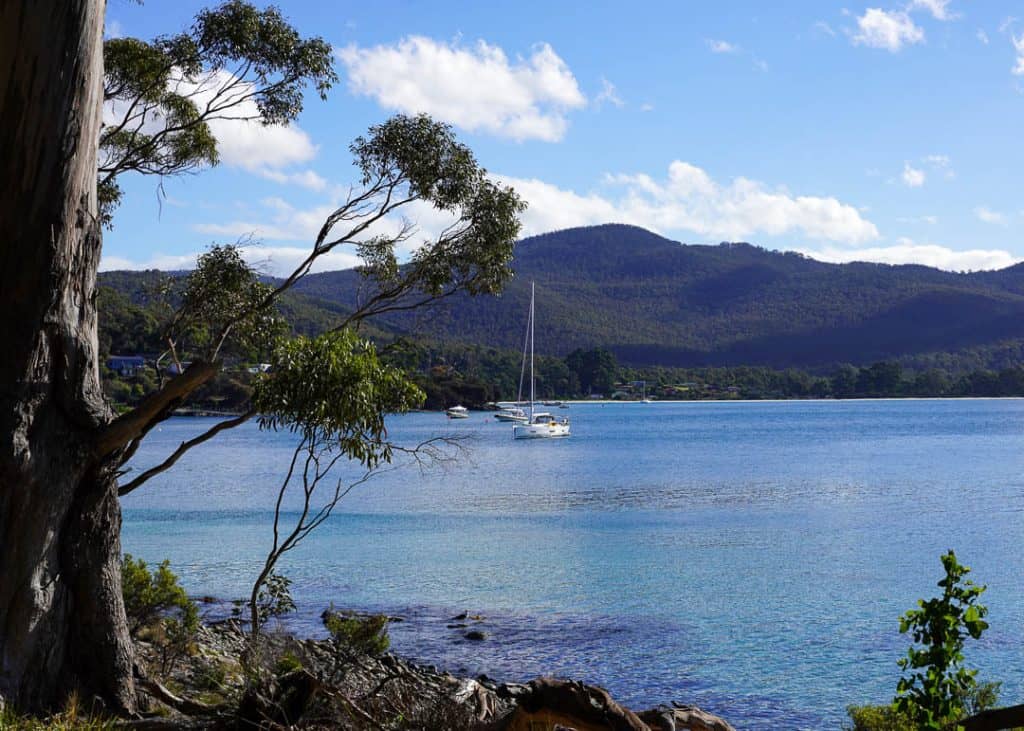
There are some picturesque beaches across the island. Just driving around will bring you to some incredible places where you want to jump out of your car and into the water. The ones that should be on your list are:
Things to do on Bruny Island besides camping
Bruny has a reputation as a food island, and it earns it. Here’s why:
The food
When camping and cooking, the cheese, the bread and a dozen oysters will do more for your trip than any restaurant.
Tours
The free things to do
Bruny Island Wildlife
White Wallabies
Bruny Island is home to a population of albino Bennett’s wallabies, with pure white fur, pink eyes and pink noses. And there are now more than two hundred of them. They are the same species as the ordinary Bennett’s Wallaby: they simply cannot produce the pigment that colours the fur. We’ve spotted a few on Adventure Bay Road, on our way to the Fluted Cape Walk.
Little penguins and short-tailed shearwaters
Both nest in the dunes at The Neck and come ashore after dark. Best between September and February. Watch from the boardwalk and keep the light off them.
Others
Echidnas, pademelons, sea eagles and a huge amount of birdlife. Drive slowly at dusk and dawn; the roads here carry an enormous amount of wildlife.
How much does a camping trip to Bruny Island cost?
Here’s what our four days actually came to. Some of the numbers have changed since. The parks pass has gone up, and the ferry fare changes on 28 September 2026, so treat this as the shape of the budget rather than the exact figure
|
What |
What we paid |
What is now |
|---|---|---|
|
Bruny Island ferry, return, car plus camper trailer |
$113 |
Changing 28 September 2026 – check current fares |
|
Camping, 3 nights at $10 per night |
$30 |
Still $10 for two people |
|
Fuel, one full tank of 75L |
$150 |
Depends on the pump at current fuel prices |
|
Food for 4 days |
$120 |
Depends on what you buy |
|
Bread from the bread fridge |
$13 |
Similar, depends on what you buy |
|
Parks Pass – daily |
$44.75 when we went |
$49.15 per vehicle |
|
Parks Pass – holiday 2 months |
$89.50 when we went |
$98.35 per vehicle |
|
Parks Pass – annual |
$95.30 when we went |
$104.75 per vehicle |
|
Total for four days |
About $525 |
Budget a little more |
Which parks pass do you need?
If Bruny is your only Tasmanian national park, a daily pass will do. If you’re travelling the state, the two-month holiday pass at $98.35 pays for itself in two daily passes. We bought the annual one because we were there for 10 weeks.
And if you’re only staying at the Neck, you don’t need a pass at all.
→ More information about parks passes https://passes.parks.tas.gov.au/
When to go and how long to stay
The best time to visit Bruny Island
December to February
December to February gives you the best weather and the best chance of seeing penguins at The Neck. It is also the busiest time of year, with school holidays.
February – March (our recommendation)
We would go again in late February or March. The water is still “warm”, the campgrounds have space, and The Neck is empty at sunrise.
September to November
This is a quieter time, cooler and the shearwaters are back
→ Whenever you go, check the wind rather than the rain. Bruny is exposed on three sides, and the ocean-facing camps get hammered when it blows. Jetty Beach is the reliable shelter.
➤ Plan the rest of your week with our 7-day island-wide itinerary.
How many days do you need on Bruny Island?
➤ Bruny Island needs three days of its own, so it does not fit into a single week in Tasmania. If you’re working out how to fit everything in, start with our Tasmania Itinerary and add Bruny to it.
Bruny Island & Tasmania Camping Map
All four campgrounds are pinned, along with the ferry terminals, the walks, the beach, plus every other campground in Tasmania if you are planning on exploring further.

Tips for camping on Bruny Island
- Bring cash. All four campgrounds use self-registration boxes.
- Bring enough drinking water.
- Check the tide before Cloudy Corner.
- Fuel up before you cross.
- Take your rubbish off the island.
- Arrive at camp before mid-afternoon in summer. There are no bookings and no overflow.
- No wood fires at Cloudy Corner. Fuel stove-only, all year.
- Keep torches off the penguins
- Drive slowly at dusk and dawn.
Is Bruny Island worth visiting?
Without hesitation. A twenty-minute ferry gets you to an island that feels a very long way from anywhere, with two of the best campgrounds in Tasmania on it, a lighthouse from 1838, white wallabies, penguins in the dunes, and some of the best food in the state.
It’s the perfect trip for anyone who likes their camping remote, their beaches empty, and their days unhurried. Give it at least four days.
Plan your trip to Tasmania
If you’re planning a camping trip to Tasmania, start with our complete guide to Camping Tasmania. For more detailed guides, check out:
Camping on Bruny Island FAQs
Can you free camp on Bruny Island?
Yes, at The Pines on Cloudy Bay Road. It is free, though you still need a parks pass to be in South Bruny National Park. The other three campgrounds cost $10 to $15 per night. You cannot camp outside the designated campgrounds.
How much does camping on Bruny Island cost?
Cloudy Corner and Jetty Beach are $10 per night for one or two people, or $15 per night for a family, plus a parks pass. The Pines is free with a parks pass. The Neck Reserve is $10 to $15 and needs no parks pass. Captain Cook Holiday Park is the paid, powered option.
Can you take a caravan to Bruny Island?
Yes. The ferry charges by vehicle length, so measure your rig first. The Neck Reserve and Captain Cook Holiday Park suit larger setups; Cloudy Corner is out because it needs a three-kilometre beach drive.
Do you need a parks pass for Bruny Island?
You need one for Cloudy Corner, Jetty Beach, The Pines and anywhere else inside South Bruny National Park. The Neck Reserve sits outside the park, so no pass is required there.
Do you need to book campsites on Bruny Island?
No. All four campgrounds are first in, first served with a self-registration box, and none of them take bookings. Bring cash and arrive before mid-afternoon in summer.
How much is the Bruny Island ferry?
Fares are based on vehicle type and length; all tickets are return fares, and pedestrians travel free. We paid $113 for a return trip for a car with a camper trailer. Visitor fares change on 28 September 2026, so check the current price before you go.
The content on Bush and Bay is based on our personal experiences and opinions. While we strive to provide accurate, up-to-date information, travel conditions and recommendations may change over time. We do not take responsibility for any decisions or actions made based on our content. Always conduct your own research and consult with professionals where necessary. Bush and Bay may earn a small commission from affiliate links, but this does not influence our reviews or recommendations. We only endorse products and places we have personally tested and believe in.
