
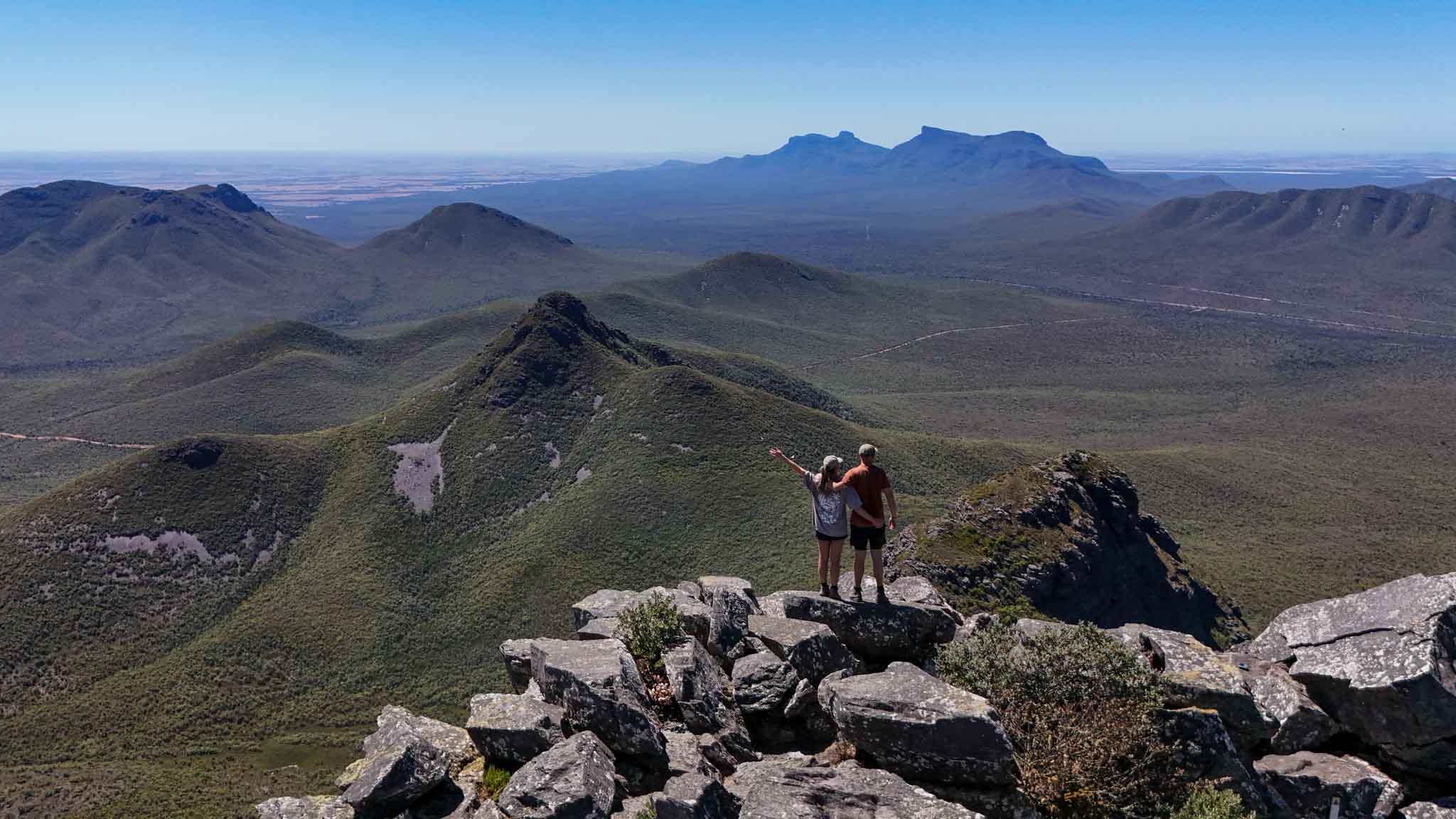
A complete Guide To The Stirling Ranges

If you’re planning a trip through Western Australia’s southwest region, chances are the Stirling Ranges are already on your list. And if they’re not, you might need to rethink your itinerary.
Most people come here for Bluff Knoll, the highest peak in South-Western Australia. But after spending a few days exploring the area ourselves, we realised there’s far more to Stirling Range National Park than just its most famous mountain.
We ended up staying longer than we’d planned. Partly because there are several incredible hikes to choose from, and partly because our legs needed a break after tackling the Bald Head Walking Trail a week earlier. (I even lost a couple of toenails… very glamorous, I know)
This guide isn’t just another list of hikes you’ll find on the national park website. We’re sharing what we genuinely thought after exploring the Stirling Ranges ourselves, including which hikes were worth it, where we camped, when we’d visit again, and what we’d do differently next time.
➤ If you’re combining your visit with Albany, don’t miss our Things to do in Albany guide, where you’ll find plenty more ideas for your Southwest road trip.
Where is Stirling Range National Park?
Stirling Range National Park, also known as the Stirling Ranges, is located around 80 km north of Albany and approximately 4.5 hours southeast of Perth. It’s an easy detour if you’re already exploring the region, and it pairs perfectly with a stop at the Albany beaches if you want to balance a big hike with a lazy afternoon by the water.
The Stirling Ranges rise fairly suddenly out of the surrounding flat farmland, which is part of what makes them feel so dramatic. You’ll see the peaks from a long way off before you actually reach them.
Do you need a permit?
Yes. To enter Stirling Range National Park, you’ll need to pay a Park Entry Fee or get a WA Park Pass. If you’re planning to visit several national parks during your Western Australia road trip, a Parks Pass usually works out as a much better value.
If you’re staying overnight at Moingup Spring Campground, you’ll also need to book a campsite and pay the separate camping fee online before you arrive.
How are the Stirling Ranges formed?
The Stirling Ranges are made up of ancient sedimentary rock, laid down as sand and mud on an old sea floor hundreds of millions of years ago, then folded and pushed upward over time. That long geological history is part of why the range has such a distinctive jagged skyline compared to the gentler hills nearby, and why the peaks here change colour so dramatically depending on the light and the weather rolling through.

Why are the Stirling Ranges so special?
The Stirling Ranges are unlike anywhere else in Western Australia. Rising dramatically from the surrounding farmland, they’re Australia’s only major mountain range in the state’s south and offer a completely different landscape to the beaches and coastline that the Southwest is known for.
One of the things that makes the park so unique is its incredible biodiversity. More than 1,500 species of flowering plants have been recorded here. With dozens found nowhere else on Earth. During spring, the mountains burst into colour with orchids, banksias, mountain bells and countless other wildflowers, making it one of the best places in Western Australia to experience wildflower season.
The higher elevation also creates a much cooler climate than the surrounding region. It’s not unusual to find mist rolling through the valleys, cool mountain air on the summits and, on very rare occasions during winter, even a dusting of snow on Bluff Knoll. It all adds to the feeling that you’ve stepped into a completely different part of Australia.
Best time to visit the Stirling Ranges
We visited in March while travelling around Australia, and although we loved it, we’d probably choose late October through November next time. That’s when the days warm up and the wildflowers are at their absolute peak. It’s one of the best wildflower spots in the whole region during this window.
Winter, from June to August, is cold and often wet, but it does have some beautiful crisp, sunny days if you time it right. You’ll just need to pack layers, because the weather up there can turn quickly.

Walking in the Stirling Ranges
There are six main trails across the range, and every single one of them is genuinely challenging. Given our fitness level (and the fact I’d already sacrificed a couple of toenails), we decided to focus on two rather than attempt all six. We did go back and forth between Mount Trio and Toolbrunup Peak, and ended up choosing Toolbrunup.
Here’s a rundown of all six, so you can decide what suits you best:
Bluff Knoll
- Class 4
- Height: 1095m
- Distance: 6km return
- Time: Allow three to four hours.
Bluff Knoll is the highest peak in the southern half of WA and is home to the most popular trail in the Stirling Ranges. You’re rewarded with outstanding 360-degree views from the top.
Mount Trio
- Class 4
- Height: 856m
- Distance: 3.5km return
- Time: Allow three hours
This one links three peaks by a plateau. The first third is steep, then it eases off. Great sweeping views of Toolbrunup and other peaks to the south-west.
Mount Hassel
- Class 4
- Height: 827m
- Distance: 3km return
- Time: Allow three hours
A popular walk with excellent views back towards Toolbrunup Peak.
Toolbrunup Peak
- Class 5
- Height: 1052m
- Distance: 4km return
- Time: Allow three to four hours.
The second highest peak in the Stirling Ranges with steep, rocky sections. It needs a fair bit of fitness and agility, but the views are magnificent.
Mount Magog
- Class 5
- Height: 856m
- Distance: 7km return
- Time: Allow three to four hours
Starts in tall wandoo woodland before opening into thicker bush, with excellent views along the way.
Talyuberlup
- Class 5
- Height: 783m
- Distance: 2.6km return
- Time: Allow three hours
Increasingly steep terrain through varied vegetation leading to a rocky crag at the summit with extensive views across the Stirling Ranges and Porongurup ranges.

Our Toolbrunup Peak Experience
Without exaggerating, Toolbrunup Peak has one of the best summit views we’ve seen anywhere in Australia. Standing on top and looking across the entire Stirling Range was absolutely mind-blowing.
But it comes at a cost:
If you’re reasonably fit and don’t mind a proper leg burn and balancing on rocks, Toolbrunup is one of the standout hikes in the range. If you’d rather ease into things, Mount Trio or Mount Hassell are a gentler introduction.
➤ As for Bluff Knoll, we’ve written a full guide on that hike since it deserves a standalone blog. Read our Bluff Knoll Guide here.

Camping in Stirling Range National Park
If you want to properly explore the range rather than just ticking off a single peak, staying overnight makes a big difference.
Moingup Spring Campground
Moingup Spring Campground is the main option inside the park. It’s new since November 2025, rebuilt after a bushfire came through about 5 years earlier. It now has flushing toilets and seven campsites, all set fairly close together. If privacy is important to you, campsite 1 is generally considered the best choice.
Camping fees apply and need to be booked online in advance. Caravans are allowed, though sites are limited and there are no showers or power facilities on site. No campfires are permitted anywhere in the park.
Camping inside the national park is limited, so if you’re visiting during wildflower season or school holidays, book as early as possible. Camping fees apply and must be booked online in advance.
If Moingup Spring is booked out, there are private campgrounds and caravan parks just outside the park’s northern boundary, as well as options near Porongurup National Park.
➤ For more ideas around Albany itself, have a look at our camping in Albany Guide.
Stirling Range Scenic drive
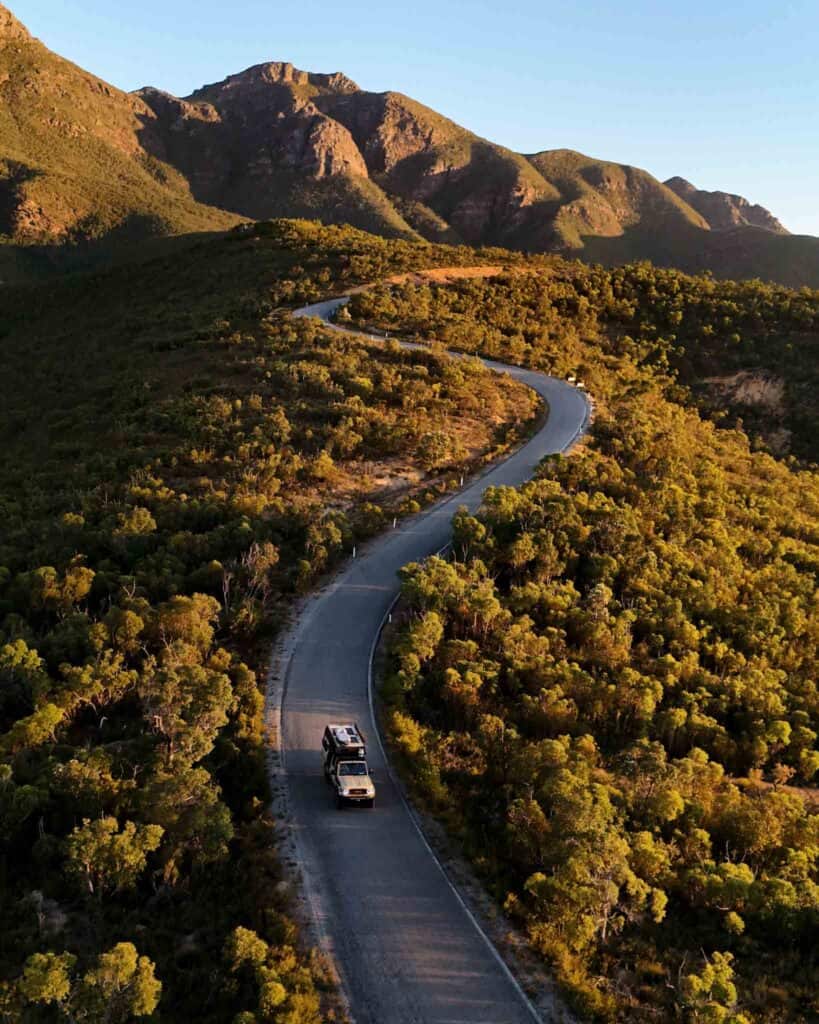
If your legs need a day off (ours certainly did), the Stirling Range Scenic Drive is a good way to still take in the mountains without another climb. It’s very scenic, winding through the range with constantly changing views of the peaks, especially around sunrise and late afternoon when the light hits the mountains. But be warned, it’s also quite corrugated, so take it slow.

Plan your Albany Trip
If you’re planning your trip to Albany, start with our complete guide to Things to do in Albany. And for more detailed information, read through our other travel and camping guides about:
FAQs about Stirling Range National Park
Do you need a WA parks pass for the Stirling Ranges?
Yes. As Stirling Range National Park is managed by WA Parks and Wildlife, you’ll need either a WA Parks Pass or you’ll need to pay the daily park entry fee when you visit. If you’re planning to visit several national parks during your Western Australia trip, a WA Parks Pass usually offers much better value.
Do you need to book camping in the Stirling Ranges?
Yes. If you’re staying at the only campground within the national park – Moingup Spring Campground – you’ll need to book your campsite online before arriving. Camping fees are separate from the national park entry fee, and sites can book out during school holidays or in peak season.
How many days should you spend in the Stirling Ranges?
We’d recommend spending at least two days in the Stirling Ranges .This gives you enough time to complete one or two hikes, enjoy the scenic drive and stay overnight without feeling rushed.
Can you visit the Stirling Ranges in a 2WD?
Absolutely. All of the main attractions, including Bluff Knoll, Toolbrunup Peak, Mount Trio and Moingup Spring Campground are all accessible in a standard 2WD vehicle. Some roads within the national park can be corrugated, so take your time and drive to conditions.
The content on Bush and Bay is based on our personal experiences and opinions. While we strive to provide accurate, up-to-date information, travel conditions and recommendations may change over time. We do not take responsibility for any decisions or actions made based on our content. Always conduct your own research and consult with professionals where necessary. Bush and Bay may earn a small commission from affiliate links, but this does not influence our reviews or recommendations. We only endorse products and places we have personally tested and believe in.
