
Coffin Bay National Park: Camping and 4WD Guide

Coffin Bay National Park is easily one of our top three national parks in South Australia, and we don’t say that lightly. We first visited in 2022 and came back a few months ago, slightly nervous that the second visit would not live up to the first.
Thankfully, it did.
In fact, Coffin Bay National Park somehow managed to impress us all over again.
We also got lucky with the weather. When we first arrived on the Eyre Peninsula, the conditions were awful. Wind, rain and absolutely no chance of enjoying the coast the way we wanted to. Luckily, we had enough time to wait it out. Once the weather settled, Coffin Bay National Park looked completely different.
That is probably the biggest lesson we have learnt here: do not rush it.
In this guide, we will share what we learnt on both trips, including the track to Black Springs, the tyre pressures that worked for us, where we would camp, how much fuel we would carry and what you can actually expect once you are inside Coffin Bay National Park.
➤ If you’re planning on staying a bit longer in this area, it’s worth starting with our Eyre Peninsula Road Trip Guide.
Where is Coffin Bay National Park?
Coffin Bay National Park is located on the southern Eyre Peninsula, about 50 kilometres west of Port Lincoln and right next to the town of Coffin Bay, famous for its oysters.
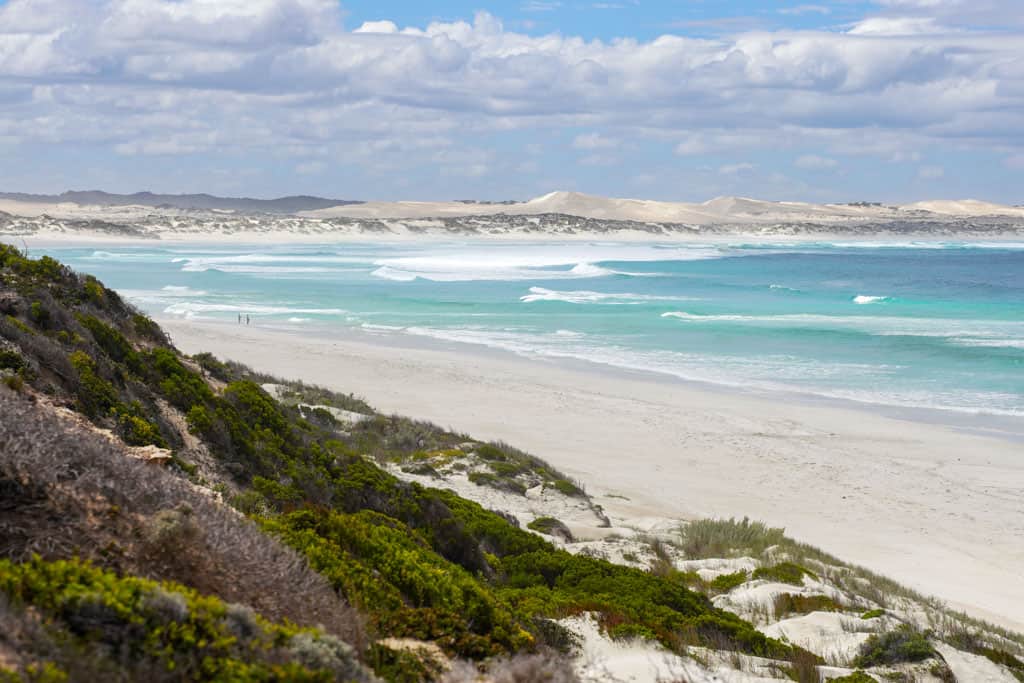
The park stretches out towards the coast, with sheltered bays and shallow water on one side and huge dunes, rocky coastline, and exposed surf beaches on the other.
It is a proper coastal wilderness, and that is what makes Coffin Bay National Park so special. You can spend the morning paddling on calm water, then be standing beside huge dunes and the ocean a few kilometres later.
If you are coming from Port Lincoln, I would stock up before you head into the national park. Port Lincoln is the place to do a proper grocery shop. Coffin Bay has a general store and fuel, and we found what we needed there, but supplies are naturally more limited than in Port Lincoln.
➤ If you are driving east from Western Australia, you can add Coffin Bay National Park to your itinerary after crossing the Nullarbor.
Do you need a 4WD for Coffin Bay National Park?
Not necessarily. But if you only have a 2WD, you will miss the part of Coffin Bay National Park that we love the most.
The park is essentially split into two very different experiences.
The southern end
The southern section is accessible by 2WD, with sealed and good gravel roads taking you towards Yangie Bay, Point Avoid, Almonta Beach Lookout and Golden Island Lookout.
Yangie Bay is a good option if you are travelling in a hire car, have a caravan or simply do not have a suitable 4WD. The campground has toilets, picnic facilities and kayak launch facilities. It makes a good base for exploring the southern end of Coffin Bay National Park.
The northern end
The northern end is where things get interesting.
This part of Coffin Bay National Park is 4WD only and includes Black Springs, Morgan’s Landing, Point Sir Isaac, Sensation and The Pool. The tracks involve soft sand, rocks, ruts and sections where conditions can change quickly and are tide-dependent.
This is also where you get the remote camping that made us fall in love with Coffin Bay National Park in the first place.
➤ If you are looking for more remote coastal 4WD adventures around the Eyre Peninsula, Memory Cove within Lincoln National Park is another one worth adding to your itinerary.
Coffin Bay National Park fees and booking
You’ll need to pay the vehicle entry permit and book your campsite through the official South Australian national parks website before you arrive. If I were you, I would sort it all out before leaving town. There’s no booth at the gate, so make sure you pay online before heading there.
For the latest fees, check the South Australian National Parks & Wildlife Service website. At the time of writing, the Vehicle Access fee was waived due to the algae bloom, and camping fees are currently $23.10 per night for the two of us.
If you want to camp at Black Springs Campground, book ahead. There are only eight allocated sites, and weekends and school holidays can fill up quickly.
The track to Black Springs
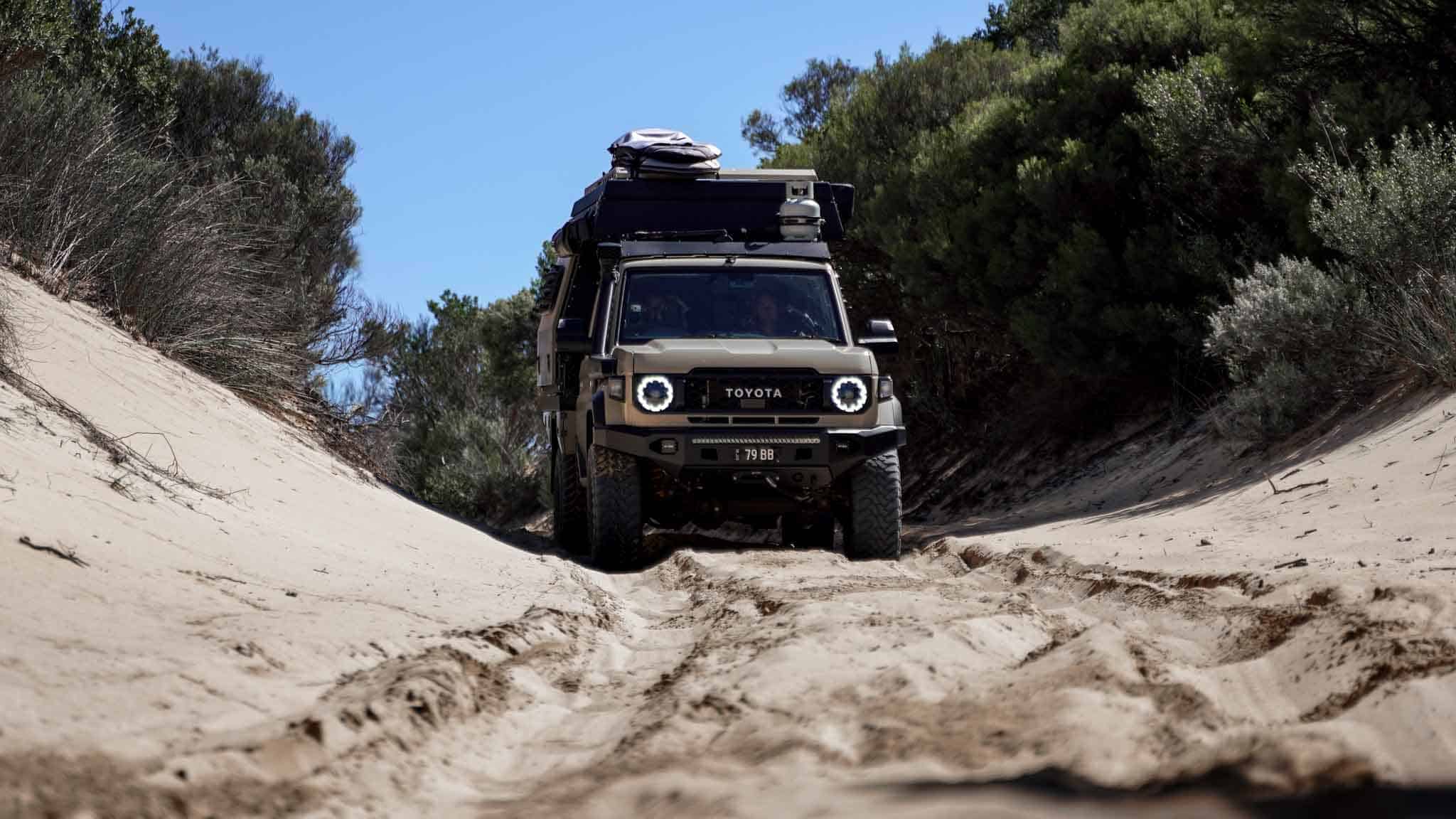
The drive from Coffin Bay to Black Springs is roughly 29 kilometres and took us about an hour. The distance is not the issue. You simply do not want to rush this track.
The first part is gravel before you reach softer sandy sections. We aired down before getting onto the sand and ran 18 psi at the front and 22 psi at the rear. That worked really well for our setup and we had no trouble getting through.
Once you are through the sand, the track becomes much rockier. You will spend a lot of the drive on hard-packed ground and rock, with some steeper climbs and descents.
It is not an especially technical track, but you do need a high-clearance 4WD and the right equipment. Conditions can change, so the tyre pressures that worked for us should not be treated as a universal recommendation.

The track to Morgan’s Landing
The track between Yangie Bay and Morgan’s Landing is worth taking more seriously. The National Parks and Wildlife Service currently warns about deep ruts, narrow sections and soft sand, with some sections occasionally affected by high tides. Sand flags and recovery equipment are highly recommended, and you should check the tide and water depth before attempting any water crossings.
How much fuel do you need?
There’s nowhere inside Coffin Bay National Park to refuel, so make sure you start with enough fuel for your entire trip, and a sensible reserve.
For our setup, we needed 20 litres for the return trip. We’ve averaged about 15 litres, but low range sand driving eats more than you’d expect and there’s nowhere to top up within the national park.
Where to camp in Coffin Bay National Park
There are several campgrounds in Coffin Bay National Park, ranging from the easy-access Yangie Bay campground to remote 4WD-only sites further north.
For us, Black Springs is the standout.

Black Springs Campground
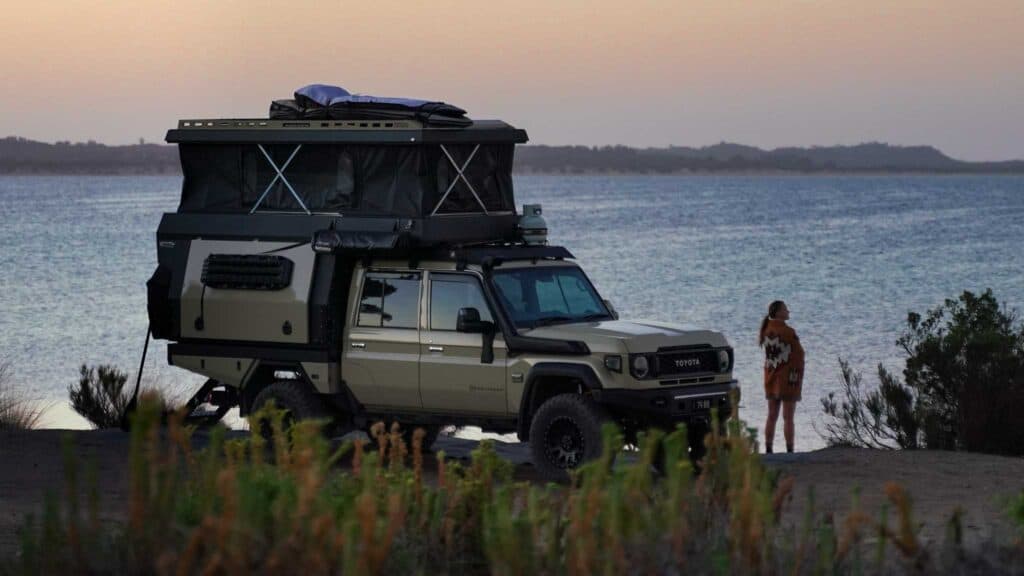
Black Springs is the campground we would happily return to again and again. It sits beside the beach, surrounded by mallee and paperbark, with beautiful views across the water.
There are seven allocated, unpowered sites and a long-drop toilet. There’s no drinking water, so you need to bring everything you need.
There are no designated firepits, but campfires can be permitted depending on conditions and fire restrictions. Check the current rules and bring your own firewood if fires are allowed.
Here’s how we would choose the sites:
- Sites 1, 2 and 3 sit next to each other and are close to the toilet. They make sense if you’re travelling with friends or with kids and want to keep the walk to the facilities short.
- Site 5 is right next to the day-use car park. It’s perfectly fine, but you will have more people moving through during the day.
- Site 6 has a beautiful view and is quite small. We would choose this one if you’re travelling with a rooftop tent or if you have a compact camping setup.
- Site 7 is still our favourite one. It’s spacious, has beautiful views and is only a short walk from the toilet and the beach.
If we had to choose, we’d book site 6 or 7.
Black Springs Overflow
We also stayed a night at Black Springs Overflow on our most recent trip, and honestly, we may have liked it even more than the main campground.
The overflow sits above the bay with beautiful views and easy access to the water. It is unallocated camping, so you do not get the same certainly as a designated site, but the location is fantastic.
The catch is the facilities. There is no toilet at the overflow, and you need to be self-contained. The nearest toilet is at Black Springs, around 600 metres away.
Yangie Bay
If you do not have a 4WD, or you travel with a caravan, Yangie Bay is your main camping option.
It’s a much easier campground, with 19 sites, toilets, a picnic shelter and kayak launch facilities. It is also suitable for caravans and larger camping setups.
It doesn’t have the remote feeling as Black Springs, but it is a practical base for exploring the southern section of Coffin Bay National Park
Big Yangie, Sensation Beach, Morgans Landing and the Pool
If you have more time and a capable 4WD, there’s plenty more to explore.
Big Yangie, Sensation, Morgan’s Landing and the Pool all offer a different version of Coffin Bay National Park, and they are worth considering if you are staying for several nights.
On our latest trip, the tides were not working in our favour and we had already found ourselves completely settled at Black Springs. We moved from Site 7 to the overflow, the water was calm and clear, and we simply did not want to leave.
So we never made it further.
Morgan’s Landing is one section we would approach with a little more caution. The current park advice specifically warns about deep ruts, narrow passages, soft sand and tidal sections on the Yangie Bay to Morgan’s Landing track. Check the conditions and tides before heading that way.
The Wildlife in Coffin Bay National Park
The wildlife is probably the best part of Coffin Bay National Park. We’ve seen a lot of wildlife while travelling Australia, but some of our best encounters have happened right here at Coffin Bay National park.
On both visits, we’ve had dolphins swimming around us while I was on the SUP, along with kangaroos around the campground, emus wandering through, rays and what looked like a baby shark in the shallows. We have also seen sea lions while relaxing at camp.
But the dolphins are the real highlight.
They have come into the bay in the morning and again around sunset during our visits. Being out on calm water at sunrise while dolphins are playing nearby is one of those travel moments that stays with you.
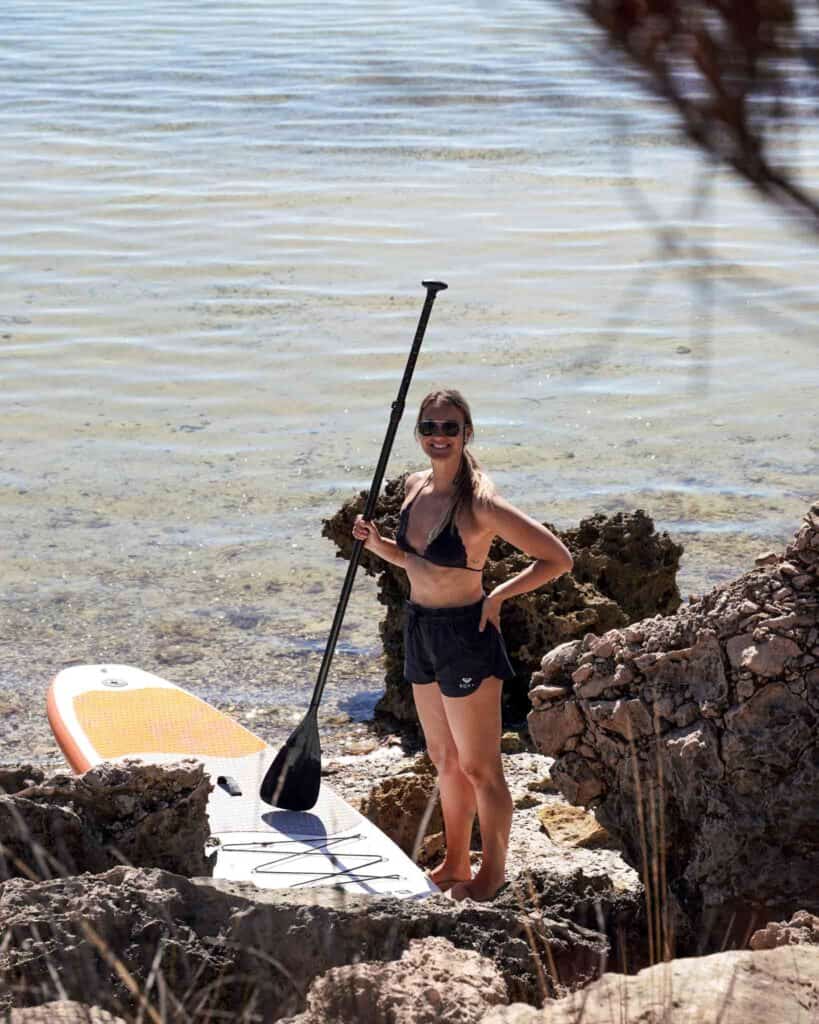
If you can fit a SUP or kayak into your setup, bring it. For us, it completely changed our experience of Coffin Bay National Park
Best time to visit Coffin Bay National Park
We’d say: autumn. Warm days, cooler nights, fewer people, and when fire restrictions allow, those lovely evenings sitting around camp after the sun goes down.
Summer is beautiful too. The water will be warmer and it is a great time for swimming and paddling, but you’ll have to deal with the crowds.
Winter can be much quieter, but rain and wind can make the tracks more challenging.
Late winter and spring are also a great time for walking and birdlife, according to the National parks & wildlife service South Australia.
Whatever season you choose, check the forecast and current park alerts before you leave. Coffin Bay National Park is exposed to the weather, and the conditions of the track can change considerably after rain, wind or tidal events.
What to bring to Coffin Bay National Park
Things to do in Coffin Bay National Park
Fishing
Fishing is one of the popular activities in Coffin Bay National Park, and there are plente of places to cast a line. Just make sure you understand the marine park zoning and sanctuary areas before you fish.
SUP or kayak
This is our number one.
When the conditions are right, the water around the sheltered bays can be calm, clear and almost completely glassy. You can paddle along the shoreline, watch the wildlife and explore places that look completely different from the land.
For us, this is what makes Coffin Bay National Park more than just another 4WD and camping destination.
Camping
Obviously.
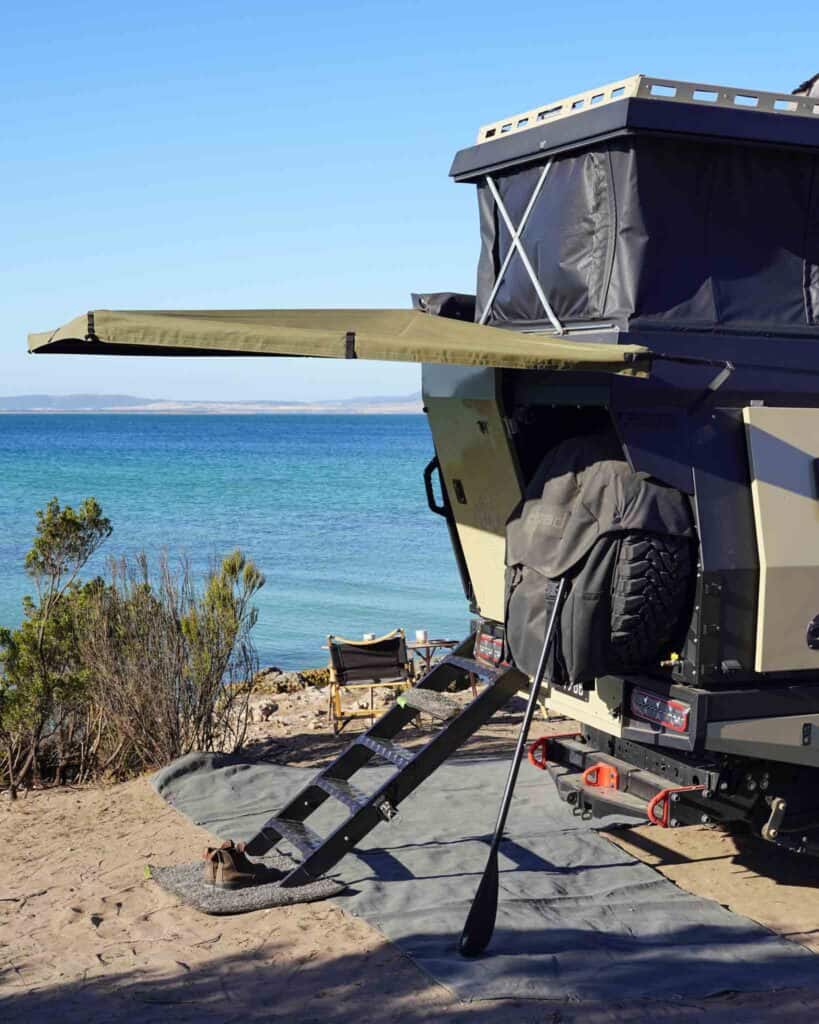
But seriously, give yourself enough time to actually enjoy it. A quick overnight stop does not do Coffin Bay National Park justice.
We would much rather spend two or three nights at Black Springs, waiting for good weather and enjoying the water, than rush through the park trying to tick off every track.
4WDing
If you enjoy driving, Coffin Bay National Park gives you a good mix of sandy sections, rock tracks, dunes and coastal scenery. Just remember that the conditions matter more than the track looks on a map.
➤ If you’re thinking of a longer Eyre Peninsula road trip around the coast 4WDing, Whaler’s Way near Port Lincoln is another special detour worth considering.
Tips before visiting coffin bay National Park
Book your campsite
Sort your camping booking before you arrive, particularly if you want one of the allocated Black Springs sites.
Pay your vehicle entry fee
Vehicle entry fee needs to be paid before entering the park.
Check fire restrictions
Fire rules can change with conditions. The park can close on days of catastrophic fire danger and may also close during extreme fire danger, so check the current advice before you leave.
Check the weather
This is probably the biggest one.
Coffin Bay National Park can look completely different depending on the wind. We have seen it in horrible weather and then watched it transform into calm, glassy water once the conditions settled.
If the forecast is bad and you have the flexibility to wait, we would.
Check the tides
This is particularly important if you are heading towards Morgan’s Landing and the northern tracks. Some sections can be affected by high tide, so check conditions before you go.
Give yourself time
The biggest mistake we made on our first trip was treating Coffin Bay National Park as a one-night stop on our Eyre Peninsula Road Trip.
It deserves more time.
The drive into Black Springs already takes around an hour, and once you are set up beside the water with good weather, you will probably find yourself asking why you ever planned to leave the next morning.
Why we love Coffin Bay National Park so much
Coffin Bay National Park is a place where the photos and videos don’t really tell the whole story.
It’s not just the 4WD track to the campground. It’s waking up beside the water, launching your sup, watching dolphins move through the bay, and sitting around a campfire when the sun goes down.
Our first visit in 2022 was incredible. Coming back with high expectations could easily have ended in disappointment, but Coffin Bay National Park somehow managed to be just as good the second time around.
If you are travelling the Eyre Peninsula, don’t make the same mistake as we did on our first visit and squeeze it into one night. Give it time. Wait for the weather. Book a good campsite. Bring a SUP or kayak. You won’t regret it. It’s absolutely worth the detour.
Plan your Eyre Peninsula Trip
If you’re planning a South Australia trip, start with our Eyre Peninsula Road Trip guide. And for more detailed information, read through our other travel and camping guides about:
Coffin Bay National Park FAQ
Is Coffin Bay National Park worth visiting?
Absolutely. Coffin Bay National Park is one of our favourite national parks in South Australia. Particularly if you enjoy remote camping, 4WDing, paddling and wildlife. The northern section feels genuinely wild, while Yangie Bay makes the park accessible for 2WD visitors too.
Where is the best place to camp in Coffin Bay National Park?
For us, Black Springs Campground is the best campground.
Can you take a caravan into Coffin Bay National Park?
You can take caravans to Yangie Bay, but the northern 4WD campgrounds are not suitable for caravans.
How long do you need in Coffin Bay National Park?
We would allow at least two nights, and ideally three or more if you have the time. That gives you some flexibility around the weather and enough time to enjoy the beaches and 4WD tracks without rushing.
The content on Bush and Bay is based on our personal experiences and opinions. While we strive to provide accurate, up-to-date information, travel conditions and recommendations may change over time. We do not take responsibility for any decisions or actions made based on our content. Always conduct your own research and consult with professionals where necessary. Bush and Bay may earn a small commission from affiliate links, but this does not influence our reviews or recommendations. We only endorse products and places we have personally tested and believe in
Testimonials do not contain any financial product advice and are based on the individual’s circumstances. Issued by Club 4X4 Pty Ltd as an AR of Lifestyle Insurance Group who is acting (under its own AFSL) on behalf of the insurer QBE Australia Limited. Excesses, limits and exclusions apply. Always read the PDS & TMD at club4X4.com.au.
