

Eyre Peninsula Travel Guide: Road Trips, Places to Visit & More

Last updated: August 2026
The Eyre Peninsula is the part of South Australia we keep on talking about. With hidden secrets around every corner. The Eyre Peninsula is home to some of South Australia’s most impressive national parks.
Sea lions will swim circles around you. You can eat oysters within sight of the racks they came off, drive fun 4WD tracks onto a beach where your tyre marks are the only ones, and see a beautiful pink lake (when the conditions are right).
And most people drive straight past it on their way to Western Australia…
We’ve explored the Eyre Peninsula twice now, and our second trip in April 2026 only confirmed what we thought on our first trip. This is a place that rewards you for slowing down. A week gets you the highlights. Two weeks and you’ll actually enjoy it. And with a 4WD, you could easily spend a month here and still be finding new places.
In this guide, you’ll find everything you need to plan your Eyre Peninsula Road Trip: where to go, how to get there, how long you need, when to visit, where to camp and the places we’d actually prioritise.
Where is the Eyre Peninsula?

The Eyre Peninsula is the big triangle of South Australia sitting between Spencer Gulf on one side and the Great Australian Bight on the other. Port Augusta at the top, Port Lincoln at the southern tip, Ceduna out west where the Nullarbor starts.
It’s big. Bigger than it looks on a map. Drive the loop from Port Augusta down to Port Lincoln, up to the west coast to Ceduna and back inland through the Gawler Ranges, and you’ll clock around 1,500 kilometres before you’ve taken a single detour. And the drive from Adelaide and back, you’re looking at 2,000 to 2,200 kilometres.
How to get to the Eyre Peninsula?
Driving from Adelaide
Most people drive. It’s about 305 kilometres from Adelaide to Port Augusta, roughly three and a half hours, and Port Augusta is where you have to make a decision.
Go coastal, and you head south from Whyalla down the Lincoln Highway, following the gulf through Cowell, Arno Bay and Tumby Bay to Port Lincoln. This is a beautiful way to see the eastern side of the peninsula if you have the time, but if you only have 10 days, we’d drive straight through to Port Lincoln.
Go inland, and you stay on the Eyre Highway west through Kimba and Wudinna, pick up the Gawler Ranges, then drop down to the west coast. This is the route we’d choose if you’re short on time or more interested in the western side of the peninsula.
If you have two weeks or more, we’d recommend making it a loop and combining the coast with the Gawler Ranges and Central Eyre Peninsula. With only 10 days, we’d focus on the southern and western coast rather than trying to see everything.
Flying in
Don’t want to drive from Adelaide?
There are three regional airports on the Eyre Peninsula:
- Whyalla
- Port Lincoln
- Ceduna
Port Lincoln is the one to aim for. It puts you within an hour of Lincoln National Park, Coffin Bay & Coffin Bay National Park and Whalers Way.
Coming from Western Australia
Crossing the Nullarbor, you’ll come into Ceduna from the west. Before you get there: there’s a quarantine station at Ceduna and another at the WA border, and you can’t take fresh fruit, vegetables, honey or plants through either one. Eat it or bin it before the checkpoint.
➤ We’ve written a guide with all the information you need when crossing the Nullarbor, if that’s the way you’re coming from or heading to.

Eyre Peninsula Map
Planning ahead matters more here than in most places, because everything’s spread out and a lot of the good stuff sits at the end of an unsealed road you can’t see from the highway.
We’ve put together our own Eyre Peninsula map with every campsite, beach, lookout and 4WD track we used across both of our trips.
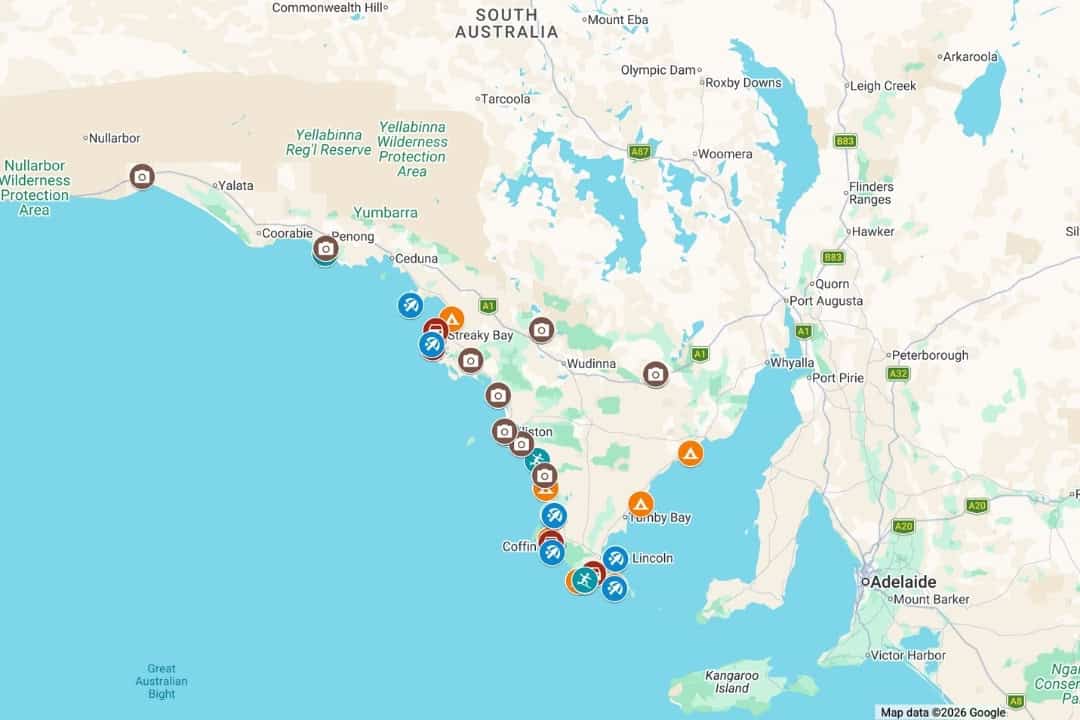
It’s easier to think about the Eyre Peninsula as five separate areas rather than one big blob:
- Eastern Eyre Peninsula: Whyalla down to Tumby Bay, along the gulf.
- Southern Eyre Peninsula: Port Lincoln, Coffin Bay, the national parks and Whalers Way.
- West Coast: Coffin Bay up through Elliston and Streaky Bay to Ceduna.
- Gawler Ranges & Central Eyre Peninsula: Inland, no coast, still worth it.
- Far West & Nullarbor: Ceduna west to the Bunda Cliffs and border.
Driving distances on the Eyre Peninsula
These are the legs we actually drove. The times assume you don’t stop, which you will.
|
Leg |
Distance |
Driving Time |
|---|---|---|
|
Adelaide to Port Augusta |
~305 km |
3.5 hrs |
|
Port Augusta to Whyalla |
~75 km |
50 min |
|
Whyalla to Cowell |
~110 km |
1.25 hrs |
|
Cowell to Tumby Bay (via Arno Bay) |
~150 km |
1.75 hrs |
|
Tumby Bay to Port Lincoln |
~50 km |
40 min |
|
Port Lincoln to Coffin Bay |
~46 km |
35 min |
|
Coffin Bay to Elliston |
~145 km |
1.75 hrs |
|
Elliston to Streaky Bay |
~105 km |
1.25 hrs |
|
Streaky Bay to Ceduna |
~110 km |
1.25 hrs |
|
Ceduna to Port Augusta (inland via Wuddinna and Kimba) |
~470 km |
5 hrs |
How long do you need on the Eyre Peninsula?
More than you think. Everyone underestimates this area.
5 – 7 days
Five to seven days gets you Port Lincoln, Port Lincoln National Park, Coffin Bay and a quick run up the west coast to Streaky Bay. You’ll have a good time, but you’ll also spend more time driving than exploring.
10 Days
Ten days is a great starting point. It gives you enough time to explore Lincoln National Park and Coffin Bay properly, spend a day at Whaler’s Way and make your way up the West Coast.
2 weeks or more
Two weeks or more is what we’d really recommend. Add extra nights in Coffin Bay National Park, Memory Cove and free camping along the west coast.
Our honest advice after two trips: pick fewer places and stay longer. This region punishes a tight schedule, because the best bits depend on tides, wind and weather you can’t do anything about.
Best time to visit the Eyre Peninsula
The best time to visit the Eyre Peninsula depends on what you’re here for.
|
Season |
What it’s like |
Best for |
|---|---|---|
|
Summer (Dec – Feb) |
Hot, dry, windy and busy. School holidays can fill up every campground in popular destinations. |
Swimming, kite surfing, surfing, snorkelling, beach days |
|
Autumn (Mar – May) |
Our pick. Warm days, cooler nights, fewer people, fire bans usually lift around mid-April. |
Camping, 4WD, hiking |
|
Winter (Jun – Aug) |
Cool and a bit wet. This is usually when the wildlife turns up. |
Southern right whales, giant cuttlefish. |
|
Spring (Sep – Nov) |
Wildflowers inland, whales still around, everything looks green, water still cold. |
Wildflowers, wildlife, quiet. |
We did both of our trips in April, and yet they were still so different. Our first time around was incredible. Warm weather and water, and not too busy. Compared to our last trip, it was very windy (same time, different year). We had many more flies the second time than the first time, and we had to hide from wind and rain for a few days in both Streaky Bay and Coffin Bay.
Our 10-Day Eyre Peninsula Road Trip Itinerary
If you’d ask us to plan your Eyre Peninsula road trip tomorrow, this is the route we’d take.
This itinerary focuses on the southern and western Eyre Peninsula, combining remote beaches, 4WD tracks, national parks, wildlife, free camping and some of the region’s most spectacular coastal scenery.
You could easily spend several weeks exploring the Eyre Peninsula, but if you only have 10 days, this route gives you a taste of the places we think are really worth your time.
This route takes you from Port Auguste to Lincoln National park, across to Coffin Bay, then following the rugged West Coast towards Streaky Bay.
What about the Eastern Eyre Peninsula?
You can absolutely take your time exploring the East Coast if you have longer, but we wouldn’t prioritise it on a 10-day trip.
Much of the drive between Port Augusta and Port Lincoln is farmland, with a handful of coastal spots worth stopping for. Point Gibbon and Lipson Cove are two places we’d consider if you have extra time, but we’d personally rater put those extra days into Lincoln National Park or Coffin Bay National Park.
But… There’s one big exception. Only if you travel in winter and if it’s on your bucket list: the giant Australian cuttlefish. If you’re travelling between May and August, Whyalla is one of the few places in the world where you can get into the water with thousands of giant Australian cuttlefish. If the timing aligns, do it. If not, we’d drive straight through.
Day 1: Port Augusta to Port Lincoln National Park
It’s a long driving day, but we’d get the eastern side of the peninsula out of the way and head straight towards Port Lincoln.
Rather than spending your first few nights ticking off coastal towns, you’re heading towards the part of the Eyre Peninsula we think is really worth slowing down for.
If you need to stock up, Port Lincoln is your last major opportunity to fill the fridge, fuel up and get everything you need for several days of remote camping and 4WDing.
From here, head into Lincoln National Park and set yourself up for the next few days.
If you’re planning to visit Memory Cove, make sure you’ve already organised your vehicle access permit, booked your campsite, and collected a key at the Visitor Information Centre before entering the park. Access to Memory Cove is restricted, and you’ll need to collect a physical key to get through the gate.
Day 2: Lincoln National Park – Sleaford-Wanna Track
Today is all about 4WDing.
Head out onto the Sleaford-Wanna track, one of our favourite 4WD tracks on the Eyre Peninsula.
The track takes you through huge sand dunes, past rugged limestone cliffs and along the Southern Ocean, with plenty of opportunities to stop and explore along the way. Allow around 3 to 4 hours for the track itself, but we’d give it a full day.
Bring a sandboard if you have one. There are designated sandboarding areas within the park.
This is exactly why we’d prioritise Lincoln National Park over the eastern coastline: you get the combination of 4WDing, beaches, dunes and wilderness all in one place.
Spend another night in Lincoln National Park.

Day 3 & 4: Memory Cove
If there’s one place we’d tell you to book ahead on this itinerary, it’s Memory Cove.
Tucked inside a Wilderness Protection Area within Lincoln National Park, Memory Cove is one of those places where the journey is almost as good as the destination.
Access is restricted to only 15 vehicles per day. Camping requires booking in advance and a key collected before you head in. The road is suitable for high-clearance 4WDs and off-road camper trailers, not for caravans. It’s a fun 4WD track that takes about one hour through a remote section of the park before you reach a secluded white-sandy beach.
This is one of the most beautiful corners on the Eyre Peninsula. Enjoy fishing, snorkelling, swimming and stand-up paddleboarding for a few days (at least).
➤ Read through our complete guide on Memory Cove for further details.

Day 5: Whalers Way
Spend the day exploring Whalers Way.
This private coastal reserve south of Port Lincoln is completely different from Lincoln National Park, with dramatic cliffs, rugged coastline, secluded beaches and spectacular ocean views.
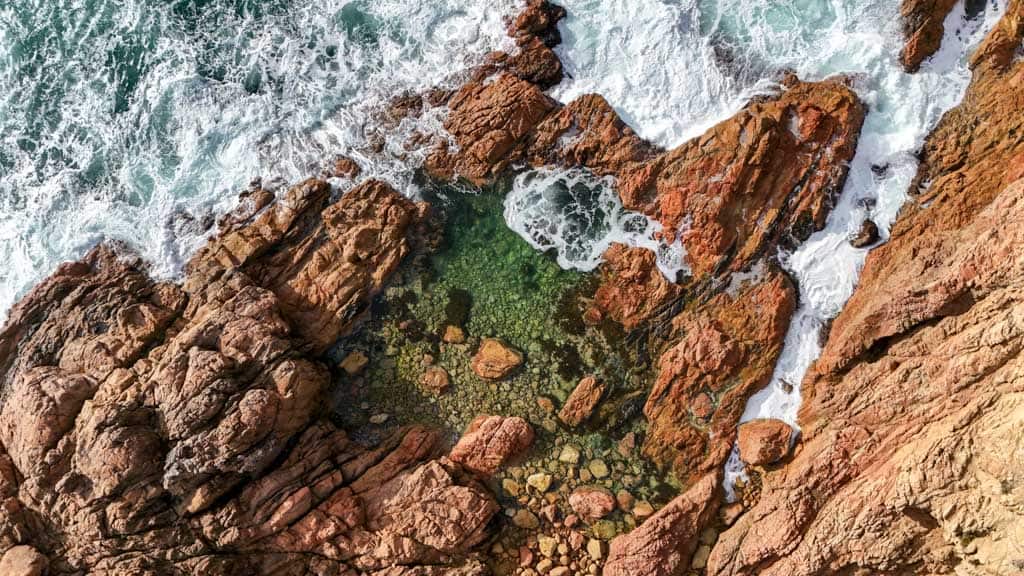
Give yourself plenty of time here rather than rushing through. Stop at the lookouts, explore the coastline, and enjoy one of the most beautiful rock pools you’ll come across in South Asutralia.
One night of camping is included in your entrance fee, so we’d stay overnight.
Day 6: Port Lincoln to Coffin Bay National Park
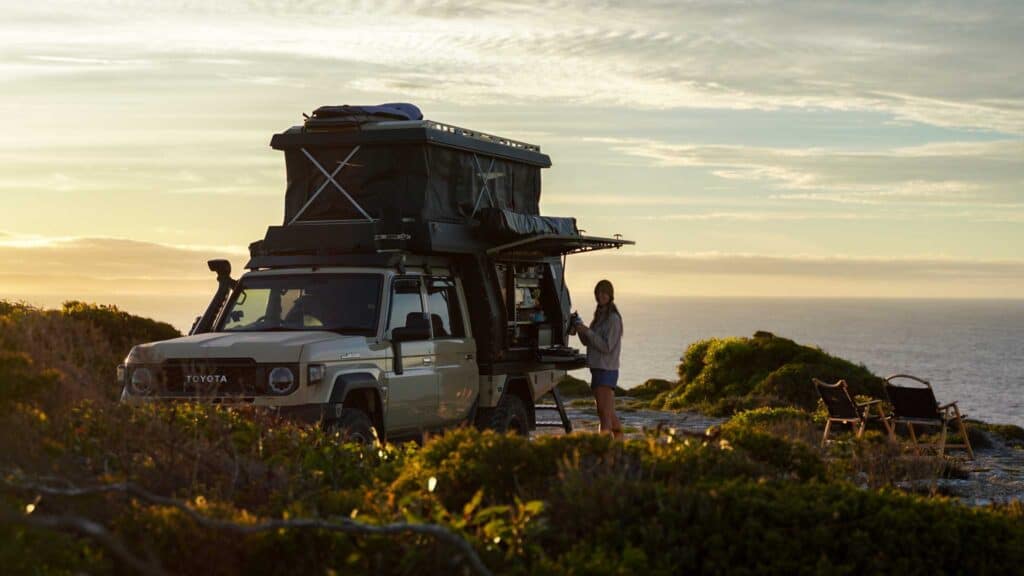
Drive across and head to Coffin Bay National Park. Before heading into the national park, this is your chance to grab any last-minute supplies and, more importantly, try some of the famous Coffin Bay Oysters.
Then head into Coffin Bay National Park.
The southern section of the park is accessible by 2WD, but the further north you travel, the more the park becomes a playground for high-clearance 4WDs, with soft sand, dunes and remote beaches.
Make your way to Black Springs Campground and settle in for the night.
Day 7: Explore Coffin Bay National Park
Depending on the tides, you can either explore the national park further north or relax a bit longer at Black Springs, go for a swim, SUP or kayak with the local dolphins. Or enjoy a day fishing.

Day 8: Coffin bay to Point Drummond
Today marks the start of your West Coast road trip.
Leave Coffin Bay and make your way towards Elliston, with plenty of stops along the way.
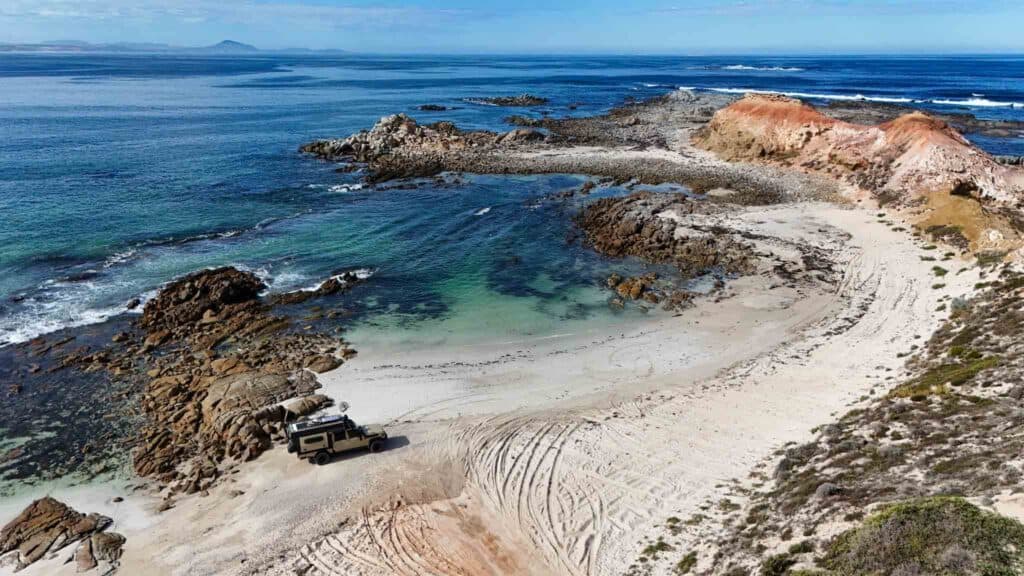
One of our favourites is Greenly Beach, where you’ll find an incredible natural rock pool surrounded by rugged coastline. Time your visit with low tide if you want to go for a swim.
Continue towards Point Drummond, where you’ll find some beautiful stretches of remote coastline and one of our free camping areas on the Eyre Peninsula.
This is where the scenery starts to change again. The sheltered bays of the Southern Eyre Peninsula give way to the exposed, rugged coastline of the West Coast.
Day 9: Elliston to Streaky Bay
Today is a big one.
Follow the Great Ocean Tourist Drive around Elliston and make your way towards Streaky Bay.
If you’re passing at the right time, stop at Colton Bakehouse for some fresh bread or rolls before continuing along the coast.
Then start working your way through the West Coast highlights. Depending on how much time you have, stops can include:
- Talia Caves
- Sheringa Beach
- Locks Well Beach
- Murphy’s Haystacks
- Point Labatt
You won’t have time to properly explore every single stop in one day, so don’t feel like you need to.
Pick the places that interest you most and spend some time there rather than rushing from one lookout to the next.
Day 10: Streaky Bay And the journey east
Before leaving Streaky Bay, make time for the Westall Way Loop.
This 32 km scenic loop takes you along some spectacular coastline south of Streak Bay, such as Smooth Pool, High Cliffs and the Granites.
From here, you have a choice. If you’re heading back towards Adelaide, start making your way east towards Port Augusta. If you’re continuing west, keep going towards Ceduna and the Nullarbor.
If you have time for one more inland detour, Pildappa Rock is worth adding to the journey east.
Have more than 10 days?
Don’t add more destinations just for the sake of seeing them. I’d recommend adding more time to the places already on this Eyre Peninsula itinerary.
Best Places to visit & Things To do Eyre Peninsula
Eastern Eyre Peninsula
The Eastern Eyre Peninsula is the gentle introduction. Farmland, small coastal towns, long jetties, calm gulf water. It’s not as dramatic as the west coast, and if you only have 10 days, we’d drive straight through.
There are a few places we’d make time for if you’re travelling slowly, particularly Point Gibbon and Lipson Cove. And if you’re travelling between May and August, Whyalla is the exception: the giant Australian cuttlefish aggregation is genuinely worth the detour.
Southern Eyre Peninsula
The Southern Eyre Peninsula is famous for its seafood, but it’s so much more. This is the heart of the Eyre Peninsula. Think pristine waters, idyllic beaches, beautiful bays and stunning National Parks. And if you explore this area with a 4WD, you’re in for a treat!
Port Lincoln is the biggest town on the Eyre Peninsula, and the base for most of the southern peninsula’s best 4WD and camping adventures.
Lincoln National Park
Lincoln National Park sits about 13 kilometres south of Port Lincoln, and if you like sand driving, you’ll have a great day here.
Sleaford-Wanna Track
The Sleaford-Wanna 4WD track is one of the main reasons to explore Lincoln National Park. It takes three to four hours to explore the big sand hills and limestone cliffs. The dunes here move constantly, so check park alerts before you go. Sometimes the western entrance is blocked by sand dunes, so you’ll have to go in and out of the main entrance.
There are also designated sandboarding areas in both Lincoln and Coffin Bay National Park. You can hire boards in town.
➤ You’ll need a vehicle entry permit to enter Lincoln National Park. You can buy your permit online through the official Parks & Wildlife website.
Memory Cove
Memory Cove is the one people remember. It’s a Wilderness Protection Area at the southern end of Lincoln National Park, and only 15 vehicles (4WDs only) are allowed in per day. You need to pick up an actual physical key from the Port Lincoln Visitor Centre to get through the gate.
The track takes 1.5 to 2 hours and requires a high-clearance 4WD. What’s at the end is a white-sandy beach in a sheltered cove, five campsites, and the feeling of being truly remote.
Book early. Weeks ahead at the absolute minimum, months if you want school holidays. You can book your campsite and park entry permit on the official Parks & Wildlife Website.
➤ We’ve put together a full guide to Memory Cove if you want the details.

Whalers Way
Whalers Way was the big addition to our last trip, and we’re so happy we did it!
It’s private property. A stretch of coast about 32 kilometres south of Port Lincoln, right on the southern tip. It’s a completely different country to the rest of the region. Limestone cliffs dropping straight into the Southern Ocean, blowholes, crevasses, sea caves and incredible rockpools.
Because it’s private, you need a permit to enter. A day pass is $40 per vehicle for up to seven people through the Port Lincoln Visitor Information Centre, and it includes one night of ‘free’ camping on the property. Extra nights are $10. You’ll get a key or gate code at the Visitor Centre, or when booking online, it’ll be sent via email.
➤ We’ve put together a full Whalers Way guide with every stop, camping information and things to do.
Coffin Bay & Coffin Bay National Park
Coffin Bay is famous for its Oyster Farm, where you can slurp delicious oysters straight from the source. But Coffin Bay National Park is why we’d go back.


This national park is known for its remote coastal scenery, picturesque bays, and friendly wildlife. The park is accessible for both 2WD and 4WD vehicles, with only the southern end accessible by 2WD. If you’re a 4WD enthusiast, you’ll quickly fall in love with Coffin Bay National Park! The park offers a variety of 4WD conditions, from sand dunes to narrow winding tracks and soft sands. A high-clearance 4WD is needed to reach the northern beaches, but you’ll find plenty of camping areas with easy beach access at Coffin Bay National Park.
You can easily spend several days at Coffin Bay National Park if you enjoy stand-up paddleboarding, kayaking or fishing. Fishing is allowed in the marine park, but not in the three sanctuary zones. You can find more information here.
You can book a campground and a vehicle entry permit on the official Parks & Wildlife website.
➤ Have a read through our full Coffin Bay National Park Guide with our favourite campground, the tracks and more details.
West Coast
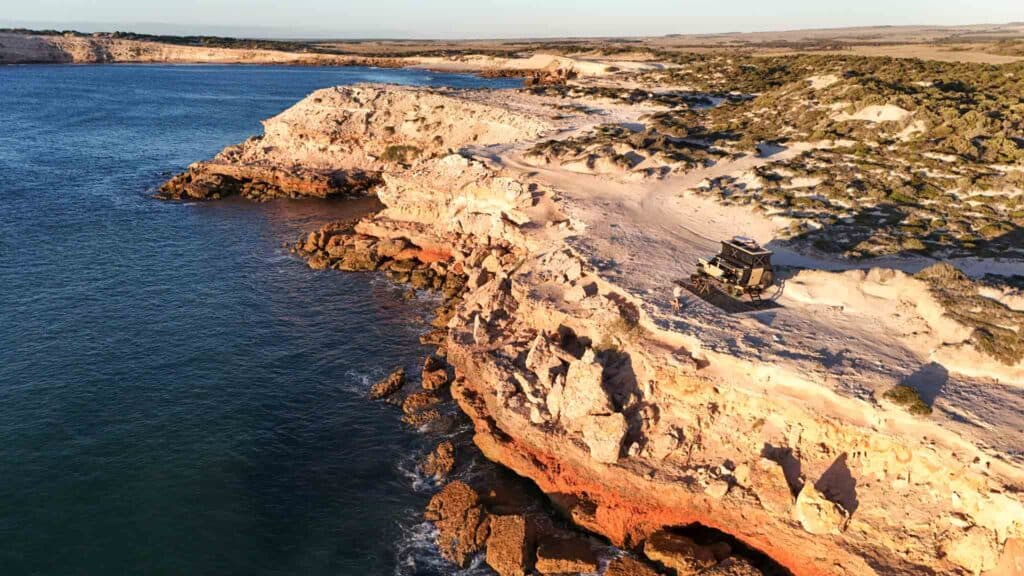
The West Coast is where the landscape stops being pretty and starts getting rugged. Cliffs, rough surf beaches, rock pools and a handful of towns that feel a long way from anywhere.
You can tackle this stretch in under three hours. But our recommendation? Don’t do it.
This stretch has the most epic lookouts and free/low-cost campgrounds you’ll find in the whole of South Australia. We’ll walk you through it:
Greenly Beach & Rockpool

Greenly Beach, on the other hand, is a proper stop. There’s a rock pool cut into the reef that’s one of the prettiest swimming spots on this coast. But go at low tide. The main beach isn’t a casual swimming spot, but known for some epic surf if the conditions are right.
There are three campgrounds here. Greenly Beach South is the one we’d pick if we were to camp here, as it’s closest to both the surf and the rock pool. Sites 8, 9 and 10 have the best views. Check the wind first, though; these sites are pretty exposed.
Point Drummond
Point Drummond was the biggest surprise of our 2026 trip. Rock pools, calmer water, and the rock out here is a burnt orange that looks unreal. There’s a very short, steep, 4WD track down to the beach. But check the tide before you go. There’s Abalone on the reef if that’s your thing.
You can camp here at the council campground.
Cummings Monument

Cummings Monument is a scenic lookout, and an epic surf break for the daredevelis.
It’s also a memorial for Leo Cummings, who came from a pioneering family in the Sheringa district. In 1959, the crayfish boat Wangaree was wrecked on the rocks at the base of these cliffs, and he died there.
If you look at the rough ocean, you’ll understand it without anyone explaining it to you.
Sheringa Beach
Sheringa Beach is a well-known surf beach with three council campgrounds.

Colton Bakehouse
Colton Bakehouse is worth a stop. You’re driving past anyway. This wood-fired bakehouse sits on the Flinders Highway at Colton, a short drive from Elliston, out in the middle of farming country, and it runs on an honesty system. Here you’ll find bread rolls, fruit buns and sourdough. Take cash! You don’t want to miss out on this one.

Elliston
Elliston is the anchor town on this coast. The Great Ocean Tourist Drive – the clifftop loop along Anxious Bay – is short, free and takes about an hour. The views are incredible, and there are sculptures along the way too, making it an ideal photo stop.

Elliston to Streaky Bay
Just north of Elliston, Talia Caves is the one everyone photographs. The Woolshed Cave is a huge granite cavern opening straight onto the ocean.
Locks Well is a long staircase down to a cliff to one of the better salmon beaches in the state. The walk back up will remind you how many steps you came down.
Murphy’s Haystacks are a cluster of pink granite boulders sitting in a paddock between Streaky Bay and Port Kenny. They’re roughly 1,500 million years old and looking as though someone dropped them there by mistake. Murphy’s Haystacks isn’t free; there’s a small fee to pay at the entrance.


Point Labatt
Point Labatt is about 40 kilometres south of Streaky Bay, out on the Calca Peninsula near Sceale Bay, and it’s the only place on mainland Australia where you can watch Australian sea lion pups learning to swim.
Streaky Bay
We spent a fair few days at Streaky Bay, hiding from the bad weather. But as soon as the sun came out and the wind dropped, this area has some of the best places to visit on the West Coast of the Eyre Peninsula:
The Westall Way Loop
The Westall Way Loop is a 30-kilometre unsealed road about 10 kilometres south of town. This loop will bring you to some rock pools, cliffs, beaches and the Granites – one of our favourite places on the Eyre Peninsula. The coastline here is exposed, and conditions can change quickly. Take care around the water and always check local conditions before surfing or swimming.
The Cape Bauer Loop
This loop is similar in length to the Westall Way Loop. It’s just north of town, with blowholes, cliff views and far fewer people on it.

Gawler Ranges & Central Eyre Peninsula
Head inland and the Eyre Peninsula changes completely. Open wheat country, big skies, and eventually the old volcanic landscape of the Gawler Ranges.
Gawler Ranges
If you have extra time, this is where we’d head inland. You’ll need a vehicle entry permit to visit Gawler Ranges National Park, and there are six campgrounds to choose from.
Pildappa Rock
Pildappa Rock is one of our favourite stops if you’re travelling east towards Port Augusta. Watching the sunrise from the rock was one of the best experiences we had in South Australia.
Country Towns
Kimba is the halfway point across Australia. Here you’ll find the big Galah, it has some awesome silo art and a great free camp.


Far West & Nullarbor
If you’re travelling to or from Western Australia, you’ll pass the famous Bunda Cliffs and the Nullarbor. In this subregion you’ll find the stunning pink Lake MacDonnell (turns out it’s only pink when the conditions are right. It seems that we’ve been extremely lucky both times), the famous surf beach Cactus Beach and Australia’s largest windmill museum in Penong. The Far West is also the best place to go whale watching in winter and to spot the majestic southern right whales.
➤ Read our full guide with tips and everything you need to know when crossing the Nullarbor.

Eyre Peninsula Camping
Camping is how we’d do the Eyre Peninsula every time. The national park campgrounds are well located within the parks with incredible views, and the free camps are some of the best ones we’ve found in South Australia.
National Park camping
Most of the parks work the same way when it comes to permits and camping fees. You’ll need to book through the South Australian Parks & Wildlife website before you turn up.
A few tips:
Free camping on the eyre peninsula
South Australia does free camping better than most states, and the Eyre Peninsula is a big part of why. You’ll find plenty of council-run free and donation camps on apps like WikiCamps. If you do plan to go free camping, know that there’s no water, toilets, or rubbish bins. Take everything in and out! Don’t be the reason a free camp gets shut down.
Know before you go
A few things we wish we’d known before our first Eyre Peninsula Trip.
Travel with a 4WD
Yes, you can see parts of the Eyre Peninsula in a 2WD, but, as always, the most memorable places are 4WD only.
Check the tides
The tides are not only important for 4WDing and beach driving, but also to have the best experiences when it comes to rock pools.
Phone coverage
Sometimes phone reception drops out in certain locations, including national parks. Download permits, offline maps or travel with a Starlink if you want to stay connected.
Fire restrictions
Fire bans remain in effect through the summer months and are generally lifted around mid-April, depending on how dry the summer was. This is the reason why we love exploring the Eyre Peninsula in April. Enjoying a campfire while camping is still one of our favourite things to do. Always check the fire restrictions before you go.
Book ahead
Campgrounds like Memory Cove or experiences such as swimming with sea lions, shark cage diving, and cuttlefish tours can sell out quickly during school holidays.
Plan your Eyre Peninsula Road Trip
Planning your Eyre Peninsula Road Trip doesn’t have to be complicated. If you want to make the most of your time here, start with these guides to help you plan your route, choose where to stay and plan your days:
The content on Bush and Bay is based on our personal experiences and opinions. While we strive to provide accurate, up-to-date information, travel conditions and recommendations may change over time. We do not take responsibility for any decisions or actions made based on our content. Always conduct your own research and consult with professionals where necessary. Bush and Bay may earn a small commission from affiliate links, but this does not influence our reviews or recommendations. We only endorse products and places we have personally tested and believe in.

2 Comments